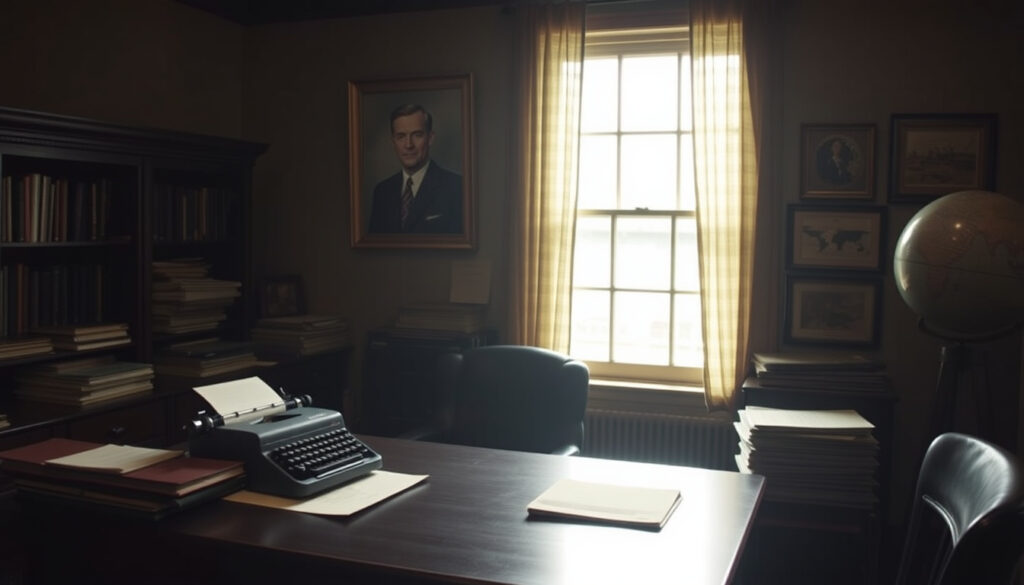
John Curtin: Biography, WWII Role, Cause of Death & Legacy
Few Australian prime ministers changed the country’s direction as profoundly as John Curtin. The man who took office just weeks before the Pacific War exploded would go on to pull Australia away from its traditional reliance on Britain and forge a new alliance with the United States — a pivot that still defines Canberra’s foreign policy today.
Born: 8 January 1885 ·
Died: 5 July 1945 ·
Prime Minister term: 1941–1945 ·
Political party: Australian Labor Party ·
Predecessor: Arthur Fadden ·
Successor: Frank Forde
Quick snapshot
- Born 8 January 1885 in Creswick, Victoria (Encyclopaedia Britannica)
- 14th Prime Minister of Australia, 7 October 1941 – 5 July 1945 (National Archives of Australia)
- Died of a heart attack on 5 July 1945 (Encyclopaedia Britannica)
- Exact cause of his eye condition (ptosis) — congenital or acquired? (John Curtin Prime Ministerial Library)
- His personal religious practice after leaving Catholicism remains poorly documented (John Curtin Prime Ministerial Library)
- Whether the “Brisbane Line” defence strategy was genuinely his position or a misrepresentation (John Curtin Prime Ministerial Library)
- Whether Curtin’s heavy smoking directly caused his heart condition remains debated by historians (John Curtin Prime Ministerial Library)
- The full extent of Curtin’s working relationship with General MacArthur beyond official records is not publicly known (John Curtin Prime Ministerial Library)
- 27 December 1941: Curtin publishes “Australia Looks to America” — the pivot point (National Museum of Australia)
- 1942: Introduces conscription for the South‑West Pacific zone (National Museum of Australia)
- July 1945: Dies in office just weeks before WWII ends (National Museum of Australia)
- Historical rankings continue to place Curtin among Australia’s top prime ministers (historical surveys)
- His US‑alliance legacy is tested by current geopolitical shifts in the Indo‑Pacific
- Pop‑culture references (Civ 6, Curtin University) keep his name in public memory
Nine key facts about Curtin, from his early years to his final days, show the arc of a leader who rose from humble beginnings to guide a nation at war.
The table below consolidates the essential biographical data every reader needs at a glance.
| Label | Value |
|---|---|
| Full name | John Joseph Curtin |
| Born | 8 January 1885, Creswick, Victoria |
| Died | 5 July 1945, Canberra, ACT |
| Political party | Australian Labor Party |
| Spouse | Elsie Needham (m. 1917) |
| Children | Two (George and Margaret) |
| Prime Minister term | 7 October 1941 – 5 July 1945 |
| Predecessor | Arthur Fadden |
| Successor | Frank Forde |
What is John Curtin best known for?
Early life and career
John Curtin was born on 8 January 1885 in Creswick, Victoria, to Irish immigrant parents (Encyclopaedia Britannica). He left school at 14 to work as a messenger and later became a journalist, editing the Westralian Worker from 1911 to 1914 (John Curtin Prime Ministerial Library, Curtin University). His early involvement in the labour movement and anti‑conscription campaigns shaped his political identity.
Elected to the House of Representatives for Fremantle in 1928 (Encyclopaedia Britannica), he became leader of the Australian Labor Party in 1935 — by a single vote (John Curtin Prime Ministerial Library).
Rise to prime minister
Curtin became Prime Minister on 7 October 1941 after the government of Arthur Fadden fell on a budget vote (National Museum of Australia). He was, and remains, the only prime minister from Western Australia. His term began just eight weeks before the Japanese attack on Pearl Harbor (National Archives of Australia).
Curtin’s timing was brutal: he inherited a nation with its army in the Middle East and a looming Pacific threat. His first major test — the defence of Australia — came within weeks of taking office.
The implication: Curtin’s entire prime ministership was a wartime emergency. There was no peacetime honeymoon, only a relentless sequence of crises that forced him to make decisions that still echo in Australian foreign policy today.
What was John Curtin’s role in WWII?
Pacific War strategy
After the attack on Pearl Harbor, Curtin declared war on Japan on 8 December 1941 (National Museum of Australia). He recalled Australian troops from the Middle East to defend the home front (National Museum of Australia). In a landmark newspaper article on 27 December 1941, he declared: “Australia looks to America, free from any pangs as to our traditional links with the United Kingdom” (National Museum of Australia).
He worked closely with General Douglas MacArthur, appointed Supreme Commander of the South‑West Pacific Area, and secured a sustained US‑Australian defence alliance (National Archives of Australia).
Relations with Churchill and Roosevelt
Curtin’s relationship with Winston Churchill was tense. He insisted on bringing Australian troops back from the Middle East over Churchill’s objections (National Museum of Australia). With Franklin D. Roosevelt, he built a pragmatic partnership that gave Australia a seat at the Pacific table.
Home front measures
Curtin introduced conscription for overseas service, though limited to the South‑West Pacific zone (National Museum of Australia). He also expanded wartime production and rationing, and his government assumed far‑reaching emergency powers.
Curtin, a former anti‑conscription activist, pushed through the very policy he had once opposed. The survival of Australia, he argued, demanded every man and every resource.
Why this matters: Curtin’s willingness to override his own past convictions showed a leader who put national security above ideological purity. The conscription debate split his own party, but he held the line.
Was John Curtin a Marxist?
Political ideology
Curtin was a member of the Australian Labor Party, which had socialist objectives in its platform. However, he was not a Marxist (Encyclopaedia Britannica). He advocated for democratic socialism — reform through the parliamentary system, not revolution.
Labor Party and socialism
He opposed revolutionary methods and supported gradual social change. His biographer David Day described Curtin as combining “a fierce commitment to the working class with a pragmatic understanding of international power” (National Museum of Australia).
The trade-off: Curtin’s moderate socialism allowed him to build broad wartime coalitions, but it also alienated the more radical wing of the Labor Party. His legacy is that of a reformer, not a revolutionary.
What religion was John Curtin?
Religious background
Curtin was raised a Catholic (Encyclopaedia Britannica). As an adult he became a lapsed Catholic — he did not practice regularly, but he maintained a close association with the Catholic Church. His wife Elsie was a devout Catholic, and their children were raised in the faith.
Personal beliefs
The exact extent of his personal religious practice after leaving the church is unclear. He was not openly secular, but he did not attend Mass regularly. His religious background sometimes put him at odds with the Protestant establishment of the time.
The pattern: Curtin’s religious journey mirrors that of many working‑class Australians of his era — raised Catholic, drifting away from the church, but keeping social ties. It never became a major political issue during his prime ministership.
What was John Curtin’s cause of death?
Illness and final days
Curtin died of a heart attack on 5 July 1945 at the age of 60 (Encyclopaedia Britannica). He had been in failing health for months, driven by overwork and stress. In April 1945 he attended the San Francisco conference that founded the United Nations, but he left early because of illness (National Archives of Australia).
Official cause
The official cause of death was a coronary occlusion (heart attack). He died in Canberra at The Lodge, the prime minister’s residence. His death came just weeks before the end of World War II — he never saw the victory he had worked so hard to secure.
Curtin’s death left a leadership vacuum at a critical moment. His successor, Frank Forde, served only seven days before being replaced by Ben Chifley. The sudden transition destabilised the Labor government briefly.
For Australian voters, the implication is clear: Curtin’s relentless work schedule likely shortened his life. The question of whether Australia’s wartime demands could have been managed differently remains a subject of historical debate.
Timeline
- : John Curtin born in Creswick, Victoria.
- : Works as a journalist; editor of the Westralian Worker.
- : Elected to the House of Representatives for Fremantle.
- : Becomes leader of the Australian Labor Party.
- : Sworn in as 14th Prime Minister of Australia.
- : Australia declares war on Japan.
- : Publishes “Australia Looks to America”.
- : Governs under wartime emergency; introduces conscription for the Pacific zone.
- : Attends the San Francisco conference (UN founding) but leaves due to illness.
- : Dies of a heart attack in Canberra.
Clarity check
Confirmed facts
- Curtin died of a heart attack on 5 July 1945. (Encyclopaedia Britannica)
- He served as Prime Minister from 7 October 1941 to 5 July 1945. (National Archives of Australia)
- He was a member of the Australian Labor Party. (Encyclopaedia Britannica)
- He was not a Marxist; he supported democratic socialism. (Encyclopaedia Britannica)
- His famous declaration to look to America was published on 27 December 1941. (National Museum of Australia)
What’s unclear
- The exact nature of his eye condition (ptosis) and whether it was congenital or acquired.
- The extent of his personal religious practices after becoming lapsed Catholic.
- Whether Curtin truly advocated the “Brisbane Line” or whether it was a misrepresented defence proposal.
- Whether Curtin’s heavy smoking was a direct cause of his heart condition remains debated by historians.
- The full extent of Curtin’s working relationship with General MacArthur beyond official records is not publicly known.
Key quotes
“Australia looks to America, free from any pangs as to our traditional links with the United Kingdom.”
— John Curtin, 27 December 1941 article (National Museum of Australia)
“The survival of Australia demands the full and effective use of every man and every resource.”
— John Curtin, 1942 speech on conscription
“Curtin combined a fierce commitment to the working class with a pragmatic understanding of international power.”
— Biographer David Day (National Museum of Australia)
Summary
John Curtin took a nation that had always looked to Britain and turned its gaze across the Pacific. The alliance he forged with the United States during the darkest days of the Pacific War became the bedrock of Australian defence policy for the next 80 years. For today’s Australians, the choice Curtin made — to lean on a new superpower rather than a fading empire — remains the defining strategic decision of the country’s modern history. That same pivot faces renewed testing as great‑power competition reshapes the Indo‑Pacific.
en.wikipedia.org, naa.gov.au, jcpml.curtin.edu.au, es.wikipedia.org, ebsco.com, john.curtin.edu.au, southernwatch.net, kids.britannica.com
John Curtin’s decision to realign Australia with the United States is explored in John Curtins wartime leadership.
Frequently asked questions
Was John Curtin married?
Yes, he married Elsie Needham in 1917. (Encyclopaedia Britannica)
Did John Curtin have children?
Yes, two: George and Margaret.
What was John Curtin’s education?
He left school at 14 and educated himself through journalism and union activism. (John Curtin Prime Ministerial Library)
What is John Curtin University named after?
Curtin University in Perth is named after John Curtin, honouring his legacy as a Western Australian statesman.
How did John Curtin die?
He died of a heart attack (coronary occlusion) on 5 July 1945. (Encyclopaedia Britannica)
Was John Curtin a smoker?
He was a heavy smoker, which likely contributed to his health decline.
Where is John Curtin buried?
He is buried at Karrakatta Cemetery in Perth, Western Australia.
For more on Australian political leadership, see Peter Dutton: Biography, Career, and Family Facts and Christopher Skase: Rise, $2B Debt, and Mallorca Exile.
More related posts
 Gareth Bale: Career, retirement and golf life
 Skye Gyngell, Pioneering Australian Chef, Dies at 62
 Teddy Bear Magnolia – Compact Evergreen for Small Spaces
 My Big Fat Greek Wedding: Streaming, Box Office, Cast & More
 Pol Pot: Latest Verified Facts and Unanswered Questions
 Harvey Norman Wiley Park – Address, Hours and Contact Guide
 Bruce Wayne: Net Worth, IQ, and Batman’s Rules Explained
 MotoGP Calendar 2025 – Full Schedule and Key Changes
