Bin Chicken Facts: What It Is and Why It’s Protected
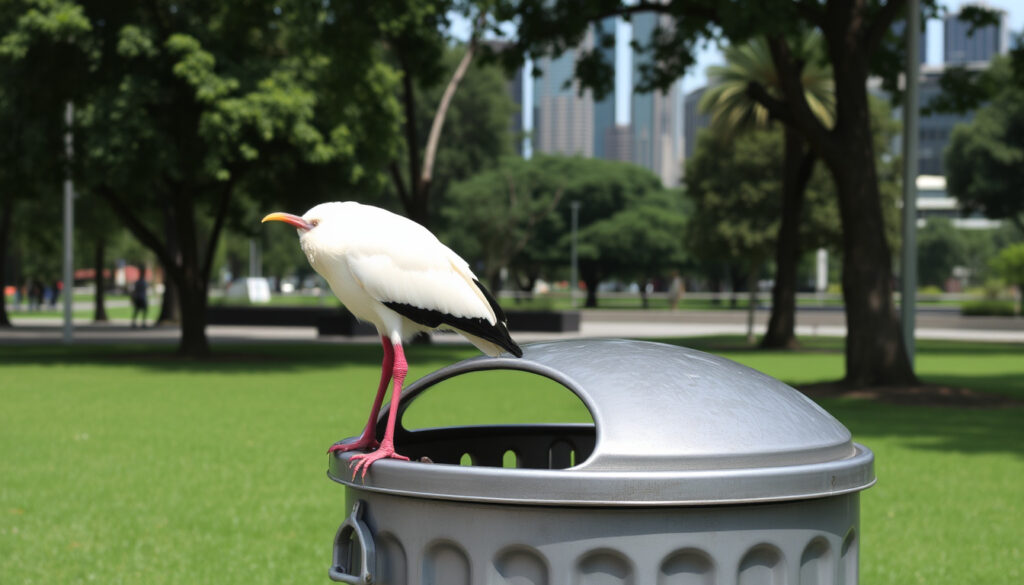
If you’ve walked through a Sydney park and spotted a large white bird with a bald black head rummaging through a trash bin, you’ve met a bin chicken, also known as the Australian white ibis (Threskiornis molucca). This native bird has traded wetlands for city streets — and it’s legally protected.
Scientific name: Threskiornis molucca ·
Common names: Bin chicken, tip turkey, dump chook ·
Native range: Eastern and northern Australia ·
Conservation status: Least Concern (IUCN) ·
Legal protection: Protected in all Australian states ·
Average wingspan: 1.1–1.2 m
Quick snapshot
- The Australian white ibis is a native Australian bird, not introduced (Redlands Coast Today).
- It is protected under state wildlife laws (Redlands Coast Today).
- Not endangered — listed as Least Concern (Australian Museum).
- Exact population numbers in urban vs. natural habitats.
- Long-term health effects of scavenging human food.
- Effectiveness of management strategies to reduce conflict.
- Whether urban ibis populations are sustainable without continued human food sources.
- Absent from Western Australia before the 1950s (Australian Museum).
- Ibis populations in Sydney’s Centennial Park declined by 90% from 1991 to 2023 (ABC News).
- Authorities urge people not to feed ibises to reduce urban clustering (Redlands Coast Today). (Rivers of Carbon)
- Conservation groups call for protecting wetland habitats (Rivers of Carbon).
Seven key facts about the bin chicken, from official records:
| Attribute | Value |
|---|---|
| Scientific name | Threskiornis molucca |
| Common names | Bin chicken, tip turkey, dump chook |
| Native range | Australia (east and north) |
| Conservation status | Least Concern |
| Legal protection | Protected in all Australian states |
| Average weight | 1.4–2.5 kg |
| Wingspan | 1.1–1.2 m |
What is a bin chicken?
Scientific name and taxonomy
- The bin chicken is the Australian white ibis (Threskiornis molucca), a wading bird in the family Threskiornithidae (Wikipedia).
- It is a native Australian species, not an introduced pest (Redlands Coast Today).
Physical description
- The Australian Museum describes it with mostly white plumage, a black head and neck, a featherless head, and a long down-curved black bill (Australian Museum).
- Adults weigh 1.4–2.5 kg with a wingspan of 1.1–1.2 m.
Why the name ‘bin chicken’?
- The nickname comes from its habit of scavenging human food scraps from open bins and rubbish dumps in urban areas (Redlands Coast Today).
- Other local names include “tip turkey” and “dump chook.”
A bird that evolved to eat crustaceans and insects now survives on chips and sandwich crusts — and turns out to be extraordinarily good at it.
What this means: the bin chicken is a native success story in urban adaptation, even if it looks like a garbage-picking outlaw.
What are bin chickens good for?
Ecological role in wetlands
- In natural habitats, ibis eat insects, crustaceans, and small vertebrates, controlling pest populations (Rivers of Carbon).
- They are considered a “canary in the coal mine” for wetland health — declines signal broader ecosystem stress (Rivers of Carbon).
Urban scavenging and waste management
- In cities, bin chickens consume human food waste, reducing organic matter in landfills (Redlands Coast Today).
- However, feeding them in parks encourages larger, more concentrated groups that can become a nuisance (Redlands Coast Today).
Cultural significance
- Bin chickens have become a pop-culture icon in Australia, featuring in memes, a Bluey episode, and even a song (ABC News).
- They also symbolise the tension between native wildlife and urban sprawl.
If ibis numbers in wetlands continue dropping while urban flocks swell, we lose a natural pest-control service in rural floodplains — and gain more bin-conflict in cities.
The catch: what helps a bird thrive in one setting may hurt it in another.
Are bin chickens protected?
Legal protection status in Australia
- Bin chickens are protected under state wildlife legislation in all Australian states (Redlands Coast Today).
- For example, Queensland’s Nature Conservation Act 1992 specifically protects them (Redlands Coast Today).
Why they are protected
- Protection is due to their native status, not because they are endangered. They remain listed as Least Concern (Australian Museum).
- Legal protection recognises that native species need safeguarding from harm and harassment, even if they are common in cities.
Penalties for harming them
- Harming or killing an ibis can result in fines or imprisonment depending on the state (Wikipedia).
- For example, the man charged with trying to cook a bin chicken faced cruelty and wildlife charges (ABC News).
The implication: being common in parks does not remove legal protection — you cannot treat a native bird like a pest.
What countries are bin chickens in?
Native range in Australia
- The Australian white ibis is endemic to Australia (Australian Museum).
- It naturally occurs in eastern and northern Australia, and has expanded into urban areas across the continent (Australian Museum).
Occurrence in other regions
- The species was absent from Western Australia before the 1950s, but its range and abundance there are now expanding (Australian Museum).
- It is also found in parts of Papua New Guinea and Indonesia (southern islands) according to some ornithological records, but populations outside Australia are not well-documented.
Introduced populations
- There are no established introduced populations in North America, Europe, or Asia (Wikipedia).
- Reports of ibis in New Zealand are likely vagrants or escaped zoo birds, not breeding populations.
The pattern: a species that once stayed in tropical wetlands has turned into a permanent urban resident across most of Australia, but hasn’t crossed major oceans on its own.
Can I touch a bin chicken?
Health risks
- Touching a bin chicken is not recommended due to potential disease transmission (e.g., salmonella) (Victorian Department of Environment).
- Like all wild birds, they can carry bacteria and parasites that affect humans.
Legal restrictions
- It is illegal to handle or disturb protected wildlife without a permit (NSW Department of Planning, Industry and Environment).
- Penalties apply even if you think you are helping an injured bird — call a wildlife rescue instead.
Safe observation tips
- Observe from a distance; do not feed or attempt to catch them (Redlands Coast Today).
- If you find an injured ibis, contact a licensed wildlife rescue organisation (e.g., WIRES in NSW).
Bin chickens are approachable and seem tame, but that familiarity masks real risk — both legal liability and potential infection. Friendly from a distance is the only safe zone.
Why this matters: urban ibis may look like easy animal encounters, but the law and your health both favour keeping your hands off.
What we know vs. what’s uncertain
Confirmed facts
- The Australian white ibis is a native Australian bird (Redlands Coast Today).
- It is protected under state wildlife laws (Australian Museum).
- It is not an introduced species (ABC News).
- It is not endangered (Least Concern) (Rivers of Carbon).
What’s unclear
- Exact population numbers in urban vs. natural habitats.
- Long-term effects of urban scavenging on ibis health.
- Effectiveness of management strategies to reduce human-ibis conflict.
- Whether urban ibis populations are sustainable without continued human food sources.
Voices from the field
“We’re reminding residents not to feed the ibises as it encourages them to gather in larger numbers and become a nuisance.”
Redland City Council, as reported by Redlands Coast Today
“The Australian white ibis is a native species that has adapted to urban environments out of necessity due to habitat loss and reduced natural flooding.”
Rivers of Carbon conservation initiative, Rivers of Carbon
“In Sydney, ibis populations in Centennial Park have declined by 90% over three decades — a dramatic shift that mirrors broader waterbird declines in the Murray-Darling Basin.”
ABC News, ABC News
What it all means
The bin chicken is not a pest that snuck into the city — it’s a native bird pushed toward human leftovers by shrinking wetlands. For Australian city councils, the challenge is clear: invest in better waste management and protect remaining floodplain habitats, or accept that urban ibis flocks will keep growing while natural populations dwindle. For residents, the responsible choice is simple: don’t feed them, don’t touch them, and let the wildlife authorities handle the rest.
Frequently asked questions
Do bin chickens only eat garbage?
No. In natural habitats they eat insects, crustaceans, and small vertebrates. Urban scavenging is a learned behaviour, not their natural diet (Redlands Coast Today).
Are bin chickens aggressive?
They are generally not aggressive toward humans, but they may steal food if approached. They can become defensive near nests (Australian Museum).
How long do bin chickens live?
In the wild, Australian white ibises typically live 10–15 years, with some records up to 20 years in captivity (Wikipedia).
What is the difference between a bin chicken and a straw-necked ibis?
The straw-necked ibis (Threskiornis spinicollis) has a darker body and a straw-like neck plumage, while the bin chicken is mostly white with a black head. Both are native Australian ibis species (Rivers of Carbon).
Can bin chickens fly?
Yes, they are strong fliers with a wingspan over a metre. They routinely fly between urban feeding sites and natural roosting areas (Australian Museum).
Why do bin chickens gather in large groups?
They are highly social birds that forage and roost in colonies. Food availability (e.g., bins or feeding by people) attracts them to the same spots (Redlands Coast Today).
What should I do if I find an injured bin chicken?
Do not handle it. Call a licensed wildlife rescue group (e.g., WIRES in NSW, RSPCA in Queensland). Handling protected wildlife without a permit is illegal (Victorian Department of Environment).
Are bin chickens related to the sacred ibis of Egypt?
They belong to the same family (Threskiornithidae) as the African sacred ibis, but they are a separate species. The Australian white ibis is not found in Africa (Wikipedia).
Related reading
- Red Rooster Near Me — another bird-themed look at Australian fast food.
- Australia Older Drivers New Laws — Australian policy changes that affect drivers, similar in legal-geographic scope.
More related posts
 Jy Simpkin: Age, Nationality, and Why He’s Under Fire in 2026
 St. Sebastian: Patron of Soldiers, Athletes, and More
 Meghan and Harry News: Verified Facts and Latest Updates
 Lil Uzi Vert: Bio, Height, Gender Identity, Net Worth & More
 Charlie Kirk’s Wife Erika Kirk: Age, Background & Inheritance
 Timberwolves vs Warriors Player Stats: Dec 12 Game
 July School Holidays 2026 Ireland: Dates & Calendar
 Bulldogs vs Eels – 22-18 Canterbury Victory Report
