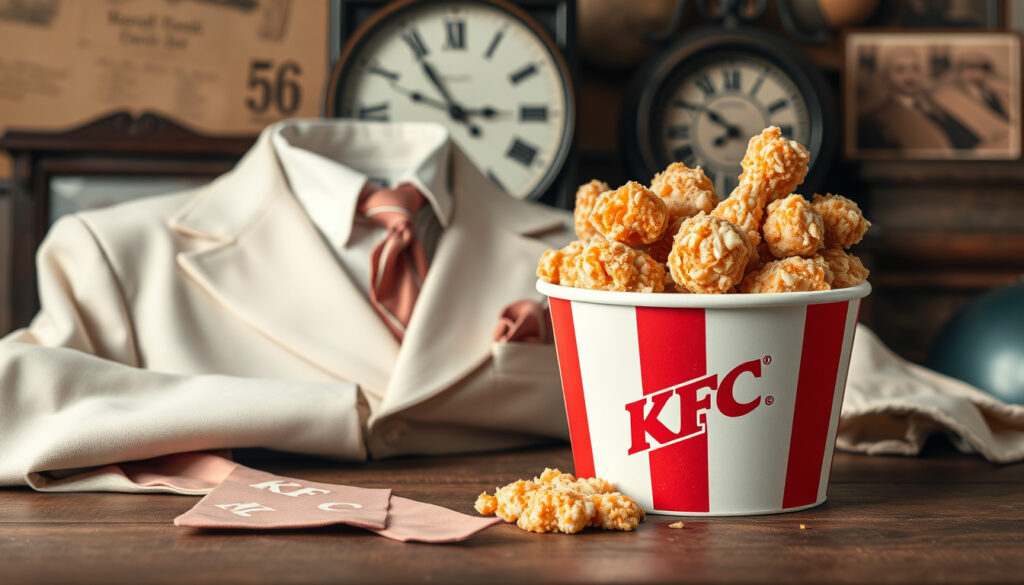
Colonel Sanders: KFC Founder, Real Name, Age, and Death
Most people treat 65 as the finish line. Colonel Sanders treated it as the starting pistol. At an age when most Americans have already retired, he began franchising the fried chicken recipe that would grow into KFC — a brand so tied to his likeness that his white suit and goatee still appear on every bucket sold worldwide.
Full name: Harland David Sanders ·
Born: September 9, 1890 ·
Died: December 16, 1980 ·
Age when founded KFC: 65 ·
Known for: Founder of KFC
Quick snapshot
- Sanders sold KFC in 1964 and did not own it afterward (Kentucky Colonelcy archive)
- He was 65 when he began franchising KFC (Encyclopaedia Britannica)
- His colonel title was honorary, awarded by the Kentucky governor in 1935 (Encyclopaedia Britannica)
- Died from pneumonia and leukemia at age 90 (Encyclopaedia Britannica)
- When exactly Sanders introduced the 7 minute freshness rule is not well documented
- His exact net worth at death varies slightly across sources
- 1935: Awarded honorary colonel title (Encyclopaedia Britannica)
- 1952: First KFC franchise opens at age 65 (Encyclopaedia Britannica)
- 1964: Sells KFC for $2 million (Kentucky Colonelcy archive)
- Sanders’ late-life entrepreneurial arc continues to be studied in business schools (UNH Rosenberg International Franchise Center)
- KFC remains a global brand under Yum! Brands (UNH Rosenberg International Franchise Center)
Eight biographical facts, one pattern: Sanders spent nearly seven decades working his way toward a breakthrough that most people would have attempted decades earlier — then built an empire from it.
| Attribute | Value |
|---|---|
| Full name | Harland David Sanders |
| Born | September 9, 1890 |
| Died | December 16, 1980 |
| Cause of death | Pneumonia and leukemia |
| Age at KFC founding | 65 |
| Net worth at death | Approximately $3.5 million |
| Spouse | Claudia Sanders (married 1949–1980) |
| Children | 3 (Margaret, Harland Jr., Mildred) |
Does Colonel Sanders still own KFC?
No. Harland Sanders sold Kentucky Fried Chicken in 1964, a decade after the first franchise opened. The buyer was a group led by John Y. Brown Jr. and Jack Massey, who paid $2 million for the company, according to the Kentucky Colonelcy archive. Sanders stayed on as a brand ambassador and remained the public face of the chain, but he no longer held any ownership stake.
Who owns KFC now?
- KFC is currently owned by Yum! Brands, which also owns Pizza Hut and Taco Bell.
- Yum! Brands was spun off from PepsiCo in 1997 and operates more than 30,000 KFC locations worldwide.
- Sanders resigned from the KFC board in 1973, severing his last formal tie to the company.
Sanders became one of the most recognizable brand mascots in history without ever owning the brand he embodied. He sold KFC for $2 million — a solid sum in 1964 — but the company would later be valued in the billions under Yum! Brands. The man in the white suit was never the man in the corner office.
What this means: Every time a customer sees the Colonel’s face on a KFC bucket, they are looking at a man who had no financial stake in what they are buying. His value to the company was entirely symbolic — and highly effective.
At what age did Colonel Sanders start KFC?
Sanders was 65 years old when he opened the first KFC franchise in Salt Lake City, Utah, in 1952, as documented by Encyclopaedia Britannica. But the story began earlier. In 1930, he operated a gas station restaurant in Corbin, Kentucky, where he served home-cooked meals to travelers, according to the UNH Rosenberg International Franchise Center.
How did Colonel Sanders start KFC?
- In 1929, Sanders opened Sanders’ Cafe in the rear of a service station in Corbin, Kentucky (Encyclopaedia Britannica).
- He perfected a pressure cooking method and a secret recipe of 11 herbs and spices that allowed him to serve fried chicken faster than traditional methods (KFC Global).
- By the early 1950s, his Corbin restaurant had gained regional attention, and he began franchising the concept to other operators.
Sanders was past the average U.S. retirement age when he signed his first franchise deal. Most entrepreneurs peak in their 30s and 40s; Sanders was drawing Social Security when his business took off. The implication for late-career professionals: it is not too late to start something that outlives you.
What this means: Sanders did not stumble into success late in life — he had been running food businesses for 25 years before the franchise model unlocked national scale. His age was a factor in the story, but so was decades of persistence.
Why was Sanders called Colonel?
The title “Colonel” was an honorary designation, not a military rank. In 1935, Kentucky Governor Ruby Laffoon awarded Sanders the distinction of Kentucky Colonel, according to Encyclopaedia Britannica. Biography.com notes that Sanders was about 40 years old at the time he received the honor.
Was Colonel Sanders a real military colonel?
- No. Sanders did serve in the U.S. Army as a young man — he reportedly dropped out of seventh grade and faked his age to enlist at 16 — but he never held a rank higher than private.
- The Kentucky Colonel title is a ceremonial commission granted by the state’s governor. It has no military authority.
- According to the Kentucky Colonelcy site, Sanders was named a colonel twice — once in 1935 and again by a later governor.
The catch: The title that became synonymous with fast-food chicken had zero military meaning. But as a branding tool, the white suit, black string tie, and “Colonel” honorific turned a cook into a cultural icon.
Did KFC try to sue Colonel Sanders?
Yes — but it was Sanders who sued KFC. After resigning from the board in 1973, Sanders grew vocal about what he saw as a decline in food quality at KFC restaurants. He filed a lawsuit against the company over changes to the recipe and preparation methods.
What was the lawsuit between Colonel Sanders and KFC about?
- The suit centered on KFC’s shift toward cost-saving preparation methods that Sanders argued compromised the taste and quality of the chicken.
- Sanders lost the lawsuit. The court ruled that as a former owner who had sold the company, he no longer had control over recipe or preparation standards.
- After the lawsuit, Sanders continued to act as a brand ambassador but with diminished influence over operations.
Why this matters: The dispute reveals a founder caught between loyalty to his product and the realities of corporate scale. Sanders wanted every batch made the way he had made it in Corbin. KFC wanted consistency across 30,000 locations. The court sided with scale.
What is the 7 minute rule at KFC?
The 7 minute rule is a KFC operational standard that requires cooked chicken to be sold within seven minutes or discarded. While the exact origins of the timer are not well documented in public sources, the policy reflects the quality-first ethos that Sanders demanded during his tenure as the brand’s ambassador.
How does the 7 minute rule affect KFC’s operations?
- Once chicken leaves the fryer, it enters a seven-minute window for sale.
- Any unsold chicken after that mark is thrown out, not held or reheated.
- The rule is designed to ensure customers always receive fresh, hot chicken — a principle Sanders fought to protect when he sued the company in the 1970s.
The trade-off: Freshness comes at a cost. A KFC location wastes a measurable amount of chicken every day to maintain the seven-minute standard. For the customer, the benefit is consistent quality. For the franchisee, it is a hit to margins that must be priced into the business model.
Timeline
- September 9, 1890: Harland David Sanders born in Henryville, Indiana (Encyclopaedia Britannica).
- 1930: Opens a gas station restaurant in Corbin, Kentucky, serving fried chicken (Encyclopaedia Britannica).
- 1935: Governor Ruby Laffoon awards Sanders the honorary title of Kentucky Colonel (Encyclopaedia Britannica).
- 1952: First KFC franchise opens in Salt Lake City, Utah, at age 65.
- 1964: Sanders sells KFC to John Y. Brown Jr. and Jack Massey for $2 million (Kentucky Colonelcy archive).
- 1973: Sanders resigns from KFC board and later sues over product quality.
- December 16, 1980: Colonel Sanders dies at age 90 from pneumonia and leukemia (Encyclopaedia Britannica).
What we know vs. what remains unclear
The record on Colonel Sanders is unusually full for a fast-food founder, but some gaps persist. Here is what the evidence confirms and what still carries uncertainty.
Confirmed facts
- Sanders did not own KFC after 1964 (Kentucky Colonelcy archive).
- He was 65 when he began franchising KFC (Encyclopaedia Britannica).
- His title “Colonel” was an honorary designation from Kentucky (Encyclopaedia Britannica).
- He died from pneumonia and leukemia (Encyclopaedia Britannica).
- KFC uses a 7 minute freshness rule for cooked chicken.
What carries less certainty
- The exact year Sanders introduced or formalized the 7 minute rule is not well documented in published sources.
- His precise net worth at death varies slightly by source — estimates cluster around $3.5 million but differ on asset valuations.
- Some details about his early business ventures before 1930 rely on biographical accounts that are not always cross-referenced.
What people said about Colonel Sanders
“Sanders became a nationally recognized entrepreneur by turning his fried chicken recipe into a franchised business.”
— UNH Rosenberg International Franchise Center
“Harland Sanders is best known for creating a fried chicken recipe that launched the world’s largest fast-food chicken chain.”
“Sanders served in the U.S. Army before working in several jobs, including firefighter, streetcar operator, and insurance salesperson.”
“Sanders received his honorary colonel’s title from the governor of Kentucky in 1935.”
— Encyclopaedia Britannica
Summary
Colonel Sanders did not build Kentucky Fried Chicken despite being 65 — he built it because he had spent the previous 35 years learning how to cook, run a restaurant, and understand what travelers wanted. His honorary title was a marketing gift that he wore better than anyone could have predicted. For anyone over 50 who feels the door has closed on a big idea, the lesson from Henryville, Indiana, is straightforward: the door does not close until you stop cooking.
Related reading: **Jimmy Page: The Real Story Behind the Myths and Net Worth**
en.wikipedia.org, thevintagenews.com, youtube.com, goodreads.com, rghf.org, facebook.com
Frequently asked questions
What was Colonel Sanders’ real name?
Harland David Sanders. He was born on September 9, 1890, near Henryville, Indiana (Encyclopaedia Britannica).
How much did KFC sell for when Colonel Sanders sold it?
Sanders sold KFC in 1964 for $2 million to a group led by John Y. Brown Jr. and Jack Massey (Kentucky Colonelcy archive).
Did Colonel Sanders ever work for another company?
Before founding KFC, Sanders worked as a farmhand, streetcar conductor, insurance salesman, firefighter, and service station operator (KFC Global).
How did Colonel Sanders get the idea for KFC?
He began serving home-cooked meals to travelers at his gas station in Corbin, Kentucky, in the 1930s. He later perfected a pressure cooking method and a secret 11-herb-and-spice recipe that allowed him to serve fried chicken quickly (KFC Global).
What did Colonel Sanders do before KFC?
He held a string of jobs: farmhand, streetcar operator, insurance salesman, firefighter, and U.S. Army enlistee. He also ran multiple service stations before opening his restaurant (KFC Global).
Did Colonel Sanders have a wife and children?
Yes. He married Claudia Sanders in 1949, and they remained married until his death in 1980. He had three children: Margaret, Harland Jr., and Mildred.
How old was Colonel Sanders when he started cooking at his gas station?
He was about 40 years old when he opened Sanders’ Cafe in Corbin, Kentucky, in 1929. He was 65 when he began franchising KFC (Encyclopaedia Britannica).
More related posts
 Catherine the Great Furniture: Erotic Legends Explained
 Low FODMAP Diet: Phases, Foods & IBS Guide
 Sky Bri: Age, Career, Relationships, and Quitting Adult Film
 Christopher Skase: Rise, $2B Debt, and Mallorca Exile
 Gabriel Macht: Why He Stopped Acting and His New Ventures
 Rowan Marshall: From Undrafted Rookie to Elite Ruckman
 OKC vs Pacers – Pacers Upset Thunder 117-114
 Amy Adams: Biography, Children, Ethnicity, Movies & FAQs
