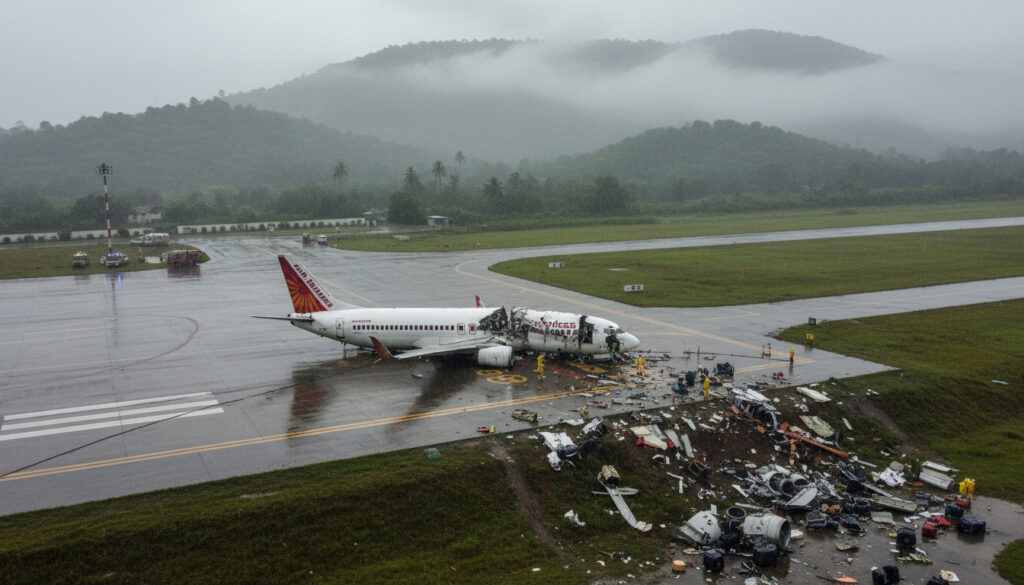
Air India Flight Crash – Kozhikode Causes and Findings
On the evening of August 7, 2020, Air India Express Flight IX1344, a Boeing 737-800 operating a repatriation service from Dubai, crashed while attempting to land at Kozhikode-Calicut Airport in Kerala, India. The aircraft overshot the table-top runway, plunged down a 110-foot embankment, and broke into three sections, resulting in 21 fatalities and injuring 169 of the 190 people on board.
The flight was part of the Vande Bharat Mission, bringing home Indian nationals stranded during the COVID-19 pandemic. Despite the devastating impact, the absence of a post-crash fire contributed to the high survival rate. The subsequent investigation by the Aircraft Accident Investigation Bureau (AAIB) identified pilot error as the probable cause, compounded by systemic operational failures and challenging weather conditions.
This report examines the sequence of events, the investigation findings, and the lingering questions surrounding compensation and accountability for one of India’s most significant aviation disasters in recent years.
What Happened in the Air India Flight Crash?
Key Insights
- Pilot error during an unstabilized approach was identified as the primary cause by the AAIB final report
- The aircraft touched down 4,438 feet into the 8,858-foot runway while carrying excessive speed
- Captain-side windshield wipers malfunctioned for 27 seconds during the critical landing phase
- Twenty-one fatalities included both cockpit crew members, while 169 passengers and crew survived
- Systemic failures at Air India Express regarding staffing and safety culture contributed to the accident
- The absence of a post-crash fire, despite a significant fuel leak, prevented additional casualties
- Investigators cited an unstabilized approach continued despite standard procedure calls for a go-around
Flight Details
| Fact | Details |
|---|---|
| Flight Number | IX-1344 |
| Route | Dubai (DXB) to Kozhikode (CCJ) |
| Aircraft Registration | VT-AXH |
| Aircraft Type | Boeing 737-800 (737-8HG WL) |
| Total Occupants | 190 (184 passengers, 6 crew) |
| Departure Time | 3:30 PM IST |
| Crash Time | 7:41 PM IST |
| Runway | 10 (Table-top, 2,950m) |
| Survivors | 169 (injured) |
| Investigation Status | Final report issued September 2021 |
What Caused the Air India Express Kozhikode Crash?
The Unstabilized Approach and Pilot Actions
Captain Deepak Vasant Sathe, an experienced aviator with previous landings at Kozhikode, continued an unstabilized approach despite the First Officer explicitly calling for a go-around. The AAIB final report concluded that the captain overcorrected during landing, touching down at approximately 4,438 feet into the 8,858-foot runway at a ground speed of 165 knots.
Investigators found that the captain failed to deploy thrust reversers in a timely manner. The report noted that overconfidence derived from extensive experience, combined with operational pressure to land in order to operate a subsequent flight to Doha the following day, likely influenced the decision-making process. Air India Express was facing acute captain shortages at the time, creating systemic pressure to maintain schedules rather than divert to alternate airports.
The investigation revealed repeated failures in Air India Express safety culture, including inadequate staffing levels and maintenance issues. These systemic deficiencies created an environment where standard operating procedures were compromised, contributing directly to the accident sequence.
Environmental and Technical Factors
Heavy rain and strong tailwinds plagued the approach to Runway 10. Air traffic control reported tailwinds at 15 knots, but actual conditions measured approximately 29 km/hr, a discrepancy that violated reporting protocols. The captain-side windshield wipers also malfunctioned for 27 seconds during the critical landing phase, obscuring visibility.
The combination of a tailwind on a short, table-top runway—a runway with steep drops at both ends—significantly reduced the margin for error. Aviation safety expert Captain M. Ranganathan noted that given the weather conditions and equipment malfunctions, the crew should have diverted to an alternate airport rather than attempting the landing.
Medical and Human Factors
Toxicology reports indicated the presence of un-prescribed anti-diabetic medications in the captain’s system, which may have caused cognitive effects or blood sugar fluctuations during the flight. This factor, combined with fatigue and operational stress, likely impaired decision-making capabilities during the critical approach phase.
Casualties and Survivors in the Air India Crash
Fatalities and Victim Profiles
The crash claimed 21 lives among the 190 occupants. Both pilots, Captain Deepak Sathe and First Officer Akhilesh Kumar, died in the impact. The majority of deceased passengers were reportedly from Kerala, returning home on the repatriation flight. The Aviation Safety Network database confirms the total fatality count and crew losses.
Rescue and Survival Factors
Despite the aircraft splitting into three sections and falling 110 feet from the runway edge, 169 people survived, many with serious injuries. The absence of a post-crash fire—despite a significant fuel leak and sheared engines—proved critical to the high survival rate. Emergency responders reached the site within minutes, extracting survivors from the wreckage amid heavy monsoon conditions.
Specific details regarding compensation amounts and final payouts to victims’ families remain undisclosed in publicly available sources. No major updates regarding settlement figures have been reported following the 2021 final investigation report.
Investigation Updates and Accountability for the Crash
AAIB Findings and Probable Cause
The Aircraft Accident Investigation Bureau of India released its final report in September 2021, identifying pilot error as the probable cause. The Times of India reported that the investigation cited non-adherence to standard operating procedures during an unstabilized approach in heavy rain and tailwind conditions.
The report documented contributory factors including Air India Express systemic failures, air traffic control’s inaccurate wind reporting, and the challenging weather environment. The detailed analysis noted that the airline’s poor staffing and maintenance culture created conditions where safety margins were routinely eroded.
Accountability and Legal Status
No criminal charges have been publicly announced against individual employees or airline executives following the investigation’s conclusion. Air India Express faced scrutiny for experiencing two deadly crashes within a decade, prompting calls for enhanced regulatory oversight of the low-cost carrier’s safety management systems.
The crash occurred during the Vande Bharat Mission repatriation efforts, when airlines operated under increased pressure to transport stranded citizens during the COVID-19 pandemic lockdowns.
Who Was the Pilot in the Air India Flight Crash?
Captain Deepak Vasant Sathe was a decorated former Indian Air Force test pilot with extensive experience operating at Kozhikode’s challenging table-top airport. His military background included service with the Indian Air Force before transitioning to commercial aviation. Despite his experience, investigators concluded that overconfidence from previous successful landings at the airport may have contributed to the decision to continue an unstabilized approach.
First Officer Akhilesh Kumar, seated in the right-hand seat, reportedly identified the unstabilized approach and called for a go-around, but the captain overruled this input. Both pilots perished when the aircraft overran the runway and plunged down the embankment. The video documentation of the aftermath confirms the cockpit section sustained fatal impact damage.
Timeline of the Air India Express Flight IX1344 Crash
- Flight IX1344 departs Dubai International Airport carrying 184 passengers, 10 infants, and 6 crew members as part of the Vande Bharat Mission repatriation effort.
- The crew aborts the first landing attempt on Runway 28 due to heavy rain and strong winds, executing a missed approach procedure.
- The aircraft initiates a second approach to Runway 10 with tailwind conditions; ATC reports winds at 15 knots, though actual speeds exceed 29 km/hr.
- The Boeing 737-800 touches down approximately 4,438 feet into the 8,858-foot runway at 165 knots ground speed; captain-side windshield wipers malfunction.
- The aircraft overshoots the runway threshold at 84 knots, breaks through the perimeter fence, and falls 110 feet down the table-top embankment.
- The fuselage splits into three sections; emergency services respond to extract 169 survivors amid monsoon conditions.
- The AAIB formally launches its investigation into the accident.
- The AAIB releases its final report identifying pilot error and systemic failures as the probable cause.
What Is Established and What Remains Uncertain?
| Established Facts | Uncertain or Undisclosed Information |
|---|---|
| Pilot error was the primary cause of the crash | Specific compensation amounts paid to victim families |
| 21 people died; 169 survived | Status of individual disciplinary actions against airline management |
| Windshield wipers malfunctioned during approach | Timeline for implementation of recommended safety improvements |
| AAIB investigation concluded in September 2021 | Current operational changes at Air India Express |
| Table-top runway geography contributed to severity | Specific medical findings regarding pilot impairment levels |
The Context of Table-Top Runway Operations
Kozhikode-Calicut Airport sits on a table-top plateau with steep drops at both ends of its single operational runway. This geographical constraint leaves no margin for error during runway overruns, a factor that has made the airport the site of previous incidents. The aviation analysis of the crash highlights that while the runway met regulatory length requirements, the combination of wet conditions, tailwinds, and the table-top design created an unforgiving environment for the unstabilized landing.
The crash occurred during the Vande Bharat Mission, when airlines faced immense pressure to repatriate citizens stranded by international COVID-19 lockdowns. This operational context may have influenced the decision to attempt landing rather than divert to alternate airports with more forgiving terrain. The What Is a Dependent Variable – Definition, Examples, Key Differences framework helps analyze how multiple dependent variables—including weather, pilot decision-making, and organizational pressure—converged to determine the accident outcome.
Expert Sources and Official Reports
“The probable cause of the accident was the non-adherence to standard operating procedures by the pilot flying, who continued the unstabilized approach and landed beyond the touch down zone, half way down the runway, in spite of ‘go around’ call by the pilot monitoring.”
— Aircraft Accident Investigation Bureau, Final Report VT-AXH
“Poor decision-making; should have diverted due to wipers and weather.”
— Captain M. Ranganathan, Aviation Safety Expert
The investigation drew upon flight data recorders, cockpit voice recordings, and meteorological reports to reconstruct the final moments of the flight. The comprehensive coverage by Indian media outlets provided ongoing documentation of the investigation’s progression from initial recovery operations through the final report publication.
Summary of the Kozhikode Air India Tragedy
The August 7, 2020 crash of Air India Express Flight IX1344 represents a tragic convergence of pilot error, systemic organizational failures, and challenging environmental conditions. While 169 people survived due to rapid emergency response and the absence of post-crash fire, the loss of 21 lives—including both pilots—prompted a comprehensive examination of low-cost carrier safety cultures and table-top runway operations in India. The investigation’s conclusion that organizational pressures contributed to the accident has implications for airline safety management systems beyond the specific carrier involved. For those examining Deja Vu Lyrics – Full Text, Meaning and Facts, the recurring themes of consequence and circumstance find tragic parallels in the documented sequence of decisions that led to this aviation disaster.
Frequently Asked Questions
What type of aircraft was involved in the Air India crash?
The aircraft was a Boeing 737-800 (737-8HG WL), registration VT-AXH, manufactured by Boeing Commercial Airplanes.
How many survivors were there from the Air India flight crash?
There were 169 survivors, all of whom sustained injuries ranging from minor to critical. The high survival rate was attributed to the absence of a post-crash fire.
What was the weather condition during the Air India crash?
Heavy rain and strong tailwinds affected the approach, with actual tailwind speeds exceeding 29 km/hr despite ATC reporting lower figures to the flight crew.
Why did the Air India Express flight overshoot the runway?
The aircraft touched down too far down the runway at excessive speed with a tailwind, leaving insufficient distance to stop before the table-top runway’s edge.
Were there any criminal charges filed after the Air India crash?
No criminal charges against individuals or airline executives have been publicly announced following the completion of the AAIB investigation in 2021.
How long did the investigation into the Air India crash take?
The AAIB launched its investigation on August 13, 2020, and published its final report in September 2021, approximately 13 months after the accident.
More related posts
 Lamine Yamal Biography: Age, Height, Parents, Net Worth
 Emma Navarro: Career, Ranking, Family, Net Worth
 Madison Elizabeth McMahon: Age, Instagram, Family & Career
 Jamie Dimon Biography: Net Worth, Health, and Politics
 Skye Gyngell, Pioneering Australian Chef, Dies at 62
 Hilarie Burton: Children, Grey Hair, and Marriage
 Unity Asset Store: Free 2D/3D Assets, Coupons Guide
 Evel Knievel: Biography, Stunts, Broken Bones, and Legacy
