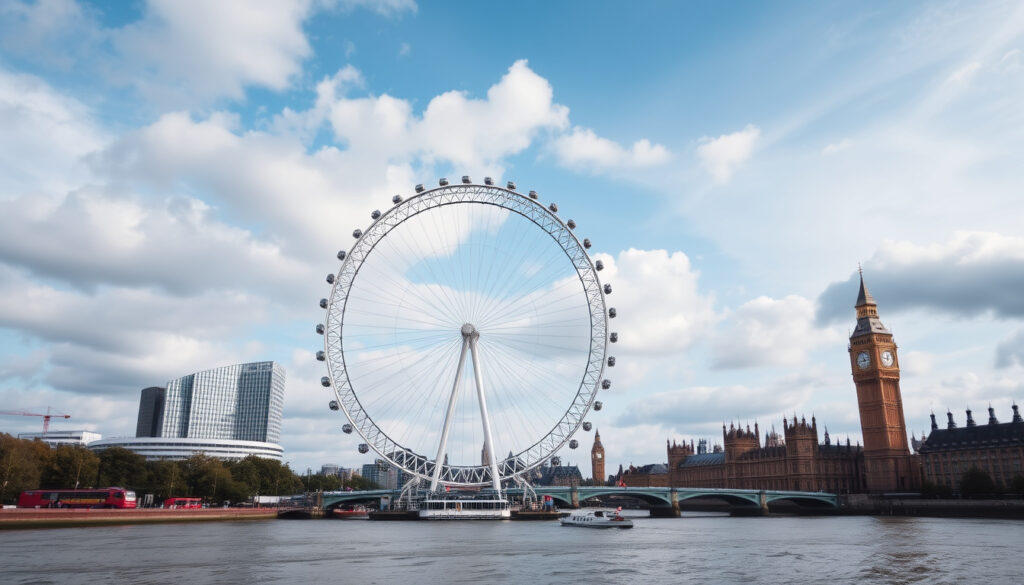
London Eye Guide: Is It Worth It? Tickets, Hours & Views
There’s a reason the London Eye still pulls in millions of visitors every year: it offers a perspective of the city that no other attraction can match. Built to mark the millennium and standing 135 metres tall, this giant observation wheel has become one of London’s most recognisable landmarks.
Height: 135 metres (443 ft) ·
Ride duration: 30 minutes ·
Capacity per rotation: 800 passengers ·
Number of capsules: 32 ·
Year opened: 2000
Quick snapshot
- Height: 135 metres (London Eye official site – visitor FAQs)
- Ride duration: 30 minutes (London Eye official site – visitor FAQs)
- Capacity: 800 passengers per rotation (Wikipedia – London Eye specifications)
- Opened in March 2000 (Wikipedia – London Eye history)
- Whether the ride is “worth it” depends on personal priorities and weather (London Tickets – day vs night overview)
- Exact queue times vary by season, hour, and crowd levels (GetYourGuide – London Eye visitor tips)
- Best time of day for the experience is subjective (Alike.io – London Eye guide)
- Opened March 2000 as the Millennium Wheel (Wikipedia – London Eye history)
- Merlin Entertainments took over sponsorship in 2005 (Wikipedia – London Eye ownership)
- Major refurbishment and new ticketing system in 2015 (Wikipedia – London Eye renovations)
- Still one of London’s top paid attractions, with ongoing seasonal events and VIP experiences (London Eye official website – what’s on)
- Post-pandemic recovery means extended hours and higher demand, especially in summer (GetYourGuide – seasonal notes)
Here is a quick breakdown of the London Eye’s key specifications.
| Specification | Detail |
|---|---|
| Year opened | 2000 |
| Height | 135 metres (443 ft) |
| Diameter | 120 metres |
| Number of capsules | 32 |
| Capacity per capsule | 25 passengers |
| Total capacity per rotation | 800 |
| Ride duration | 30 minutes |
| Location | South Bank of the River Thames, London |
| Architect | David Marks and Julia Barfield |
The pattern: these numbers define a wheel built for volume and steady rotation, not speed.
Is it worth sitting on London Eye?
That depends on how you measure value. The standard 30-minute rotation costs between £29 and £35 for a walk-up adult ticket in 2025, according to Alike.io’s London Eye guide (travel blog with current pricing). Buying online in advance nearly always undercuts the walk-up price, as the official website confirms.
At roughly £30 for 30 minutes, the London Eye costs about £1 per minute. For a family of four that adds up fast. The catch: you cannot replicate that aerial view of Big Ben, the Houses of Parliament, and the Thames from anywhere else at that height.
How much does it cost to go on the London Eye?
- Adult standard: approximately £29–£35 walk-up, less online (Alike.io 2025 pricing)
- Fast-track tickets: roughly £38–£45 (Alike.io fast-track pricing)
- Online advance purchase always cheaper per London Eye official FAQs
Are there 2 for 1 ticket offers for the London Eye?
Yes – National Rail’s 2-for-1 deal, valid with a same-day train ticket to London, can be used at the London Eye. The offer is generally available through the Days Out Guide (official National Rail scheme), but terms change annually, so check before booking.
What is the value compared to other London attractions?
At 30 minutes, the London Eye offers a longer single experience than the Shard viewing platform (unlimited time, but higher ticket price) and a shorter experience than a river cruise. It’s a premium-view product, not a full-day activity. London Tickets (ticketing reseller) notes that the Eye’s uniqueness lies in the slow, panoramic sweep – something static observatories don’t match. For a different kind of landmark experience, see our Machu Picchu Travel Guide.
The implication: your decision hinges on whether you value that unique aerial perspective over the cost.
What is special about London Eye?
At 135 metres, it was the tallest observation wheel in Europe when it opened, and its cantilevered design – a single A-frame support – remains distinctive. Wikipedia details its 32 egg-shaped capsules, each holding up to 25 passengers, and notes that at the time of its construction the structure involved engineering techniques never before used on a passenger wheel.
What landmarks can you see from the London Eye?
On a clear day you can see up to 25 miles, according to London Tickets. The rotating capsule offers views of:
- Big Ben and the Houses of Parliament
- The Shard
- St Paul’s Cathedral
- Tower Bridge and the Tower of London
- The River Thames snaking east and west
What are five facts about the London Eye?
- Each capsule weighs around 10 tonnes (Wikipedia specifications)
- The wheel rotates at 0.26 m/s – slow enough to let you walk on and off (London Eye FAQs)
- It has 32 capsules representing the 32 boroughs of London (Wikipedia symbolism)
- Capacity per full rotation: 800 passengers (Wikipedia capacity)
- It won a British Constructional Steelwork Association design award in 2000 (Wikipedia awards)
Daytime visitors in summer often get flat, hazy light by midday – not ideal for photos. The view is best in early morning or late afternoon, regardless of season.
The catch: its uniqueness means no other spot gives you that slow, elevated tour of the city’s core.
How long is one ride on the London Eye?
One full rotation takes exactly 30 minutes – that is the standard experience. GetYourGuide (travel booking platform) adds that the wheel may slow slightly when boarding elderly or disabled passengers, extending the ride by a few minutes.
Does the London Eye stop during the ride?
No – the wheel moves continuously at a slow pace (0.26 m/s). Passengers board while the capsule is moving, though the carousel slows to a near-walk pace, not a full stop. The official FAQ confirms the ride is “one continuous revolution”.
How long does boarding take?
Boarding adds about 5–10 minutes. GetYourGuide recommends allowing 1 to 2 hours total for the visit, including queue time, which averages 20 minutes but can spike to 60 minutes on peak days.
Ride: 30 min ·
Boarding: 5–10 min ·
Queue (average): 20 min ·
Total visit: 45–90 min
The pattern: the total time commitment is manageable, but queue variability is the main variable to manage.
What is the London Eye called now?
The official name remains London Eye. It was originally called the Millennium Wheel when it opened in March 2000, but that name was quickly dropped. The Eye has had several sponsors: British Airways (2000–2005), then Merlin Entertainments (2005 onward). Wikipedia’s entry notes that despite sponsorship changes, the public name has been “London Eye” for over two decades.
What was the London Eye originally called?
The Millennium Wheel – a temporary name chosen to tie into the millennium celebrations. It was never intended as a permanent name, according to Wikipedia’s naming history.
Has the London Eye changed names over time?
No official name change beyond the initial transition from Millennium Wheel. Sponsored names (e.g., British Airways London Eye) are used in official materials but the public calls it the London Eye. There is no common alternative name today.
The implication: no need to worry about outdated names – just call it the London Eye.
Is it better to do the London Eye at day or night?
The answer depends on what you want from the experience: daylight gives you sharp landmark spotting; night gives you a glittering cityscape. London Tickets (ticketing information site) explains that night visits are less crowded and more serene, while daytime rides feel busier and more touristy.
What are the London Eye opening and closing times?
Generally 11:00–18:00 daily, with extensions on Fridays and Saturdays (10:00–20:30), per GetYourGuide. Summer months have longer evening hours – sometimes open until 21:00, especially weekends.
When is the best time of day for clear views?
- Daytime: clear visibility of landmarks, but midday summer light is flat and queues are worst (Alike.io timing tips)
- Sunset (1 hour before): golden light, iconic silhouette views, but busiest slot (Alike.io best single time slot)
- Night: fewer crowds, illuminated skyline, romantic atmosphere (London Tickets night experience)
- Early morning (weekdays): shortest queues (GetYourGuide timing strategy)
First-time tourists wanting orientation: pick a pre-booked early morning or daytime slot. Couples or return visitors: choose sunset or evening for atmosphere. Budget visitors: weekday mornings are cheapest and quietest.
The pattern: your choice of time slot directly affects both your view and your waiting time.
How to plan your London Eye visit
- Book online in advance – guarantees the lowest price and a time slot. Walk-up is always more expensive (London Eye official FAQs).
- Choose your time wisely – early morning or late afternoon for shorter queues; avoid midday on weekends and school holidays (GetYourGuide best times).
- Arrive 15 minutes early – your position in the queue affects which side of the capsule you board first (Alike.io arrival tip).
- Consider a fast-track ticket if queue aversion is high – reduces wait to 5–10 minutes (GetYourGuide fast-track info).
- Check the weather before you go – clear skies make a massive difference. Overcast days limit visibility to a few kilometres.
The implication: a little advance planning can turn a potentially frustrating wait into a smooth experience.
London Eye timeline
- 1998 – Construction begins on the South Bank (Wikipedia construction)
- March 2000 – Opens to the public as the Millennium Wheel (Wikipedia opening)
- 2005 – Merlin Entertainments takes over sponsorship (Wikipedia ownership)
- 2015 – Major refurbishment and new ticketing system (Wikipedia refurbishment)
- 2020 – Temporary closure due to COVID-19 pandemic; reopened with reduced capacity (Wikipedia closure)
The pattern: the Eye’s history shows steady investment and adaptation, not stagnation.
What we know and what we don’t
Confirmed facts
- Height of 135 metres
- Ride duration of 30 minutes
- 32 capsules carrying up to 25 passengers each
- Capacity of 800 passengers per full rotation
- Opened in March 2000
- Online tickets are cheaper than walk-up
What’s unclear
- Best time of day – subjective; depends on preference for light vs atmosphere
- Exact queue times – vary by season, day of week, and hour
- Whether the experience is “worth it” – depends on budget and expectations
- The actual visibility range varies greatly with weather; clear days can see up to 25 miles but overcast days reduce it significantly
- Whether the standard ticket is worth the price is a personal budget decision
- Whether day or night is better comes down to the visitor’s priorities
The pattern: most uncertainty revolves around subjective trade‑offs, not factual gaps.
London Eye specifications at a glance
The table below summarizes the key dimensions and details.
| Specification | Value |
|---|---|
| Height | 135 m (443 ft) |
| Diameter | 120 m |
| Rotation speed | 0.26 m/s (about 30 min per revolution) |
| Number of capsules | 32 |
| Capacity per capsule | 25 passengers |
| Total capacity | 800 passengers per rotation |
| Location | South Bank, London |
| Architects | David Marks & Julia Barfield |
The implication: these numbers confirm a wheel built for mass, steady sightseeing rather than speed or thrills.
Upsides and downsides
Upsides
- Unmatched 360° panoramic views of central London
- Slow rotation allows plenty of time for photos
- Accessible for wheelchairs (ramp and step-free boarding)
- Multiple ticket tiers (standard, fast-track, champagne, private capsule)
- Centrally located on the South Bank
Downsides
- Relatively expensive for a 30-minute experience
- Weather dependent – poor visibility can ruin the view
- Crowds can mean long queues, especially weekends and summer
- Not a thrill ride – no speed or dropping sensations
- No stopping – must board and alight while moving
The pattern: the trade‑off is clear – iconic views versus cost and crowds.
What visitors say
“The view from the London Eye is simply breathtaking. You can see up to 40 km on a clear day, taking in Big Ben, the Shard, and the winding Thames.”
– London Eye official website (visitor description)
“We booked fast-track tickets and it made all the difference. The queue was only about 10 minutes, while the standard line looked like it would take over an hour.”
“The London Eye was at the time the tallest observation wheel in Europe, and the first to use a cantilevered hub-and-spoke design on this scale.”
– Wikipedia (technical analysis)
The implication: visitors consistently highlight the view and the value of fast‑track, while experts underline its engineering significance.
Summary
The London Eye is not a budget attraction, but it delivers a perspective you cannot get anywhere else in London. The 30-minute rotation forces you to slow down and actually look at the city, rather than just snap a photo and leave. For visitors on a budget, the choice is clear: book a standard online ticket for a weekday morning, or invest in fast-track if your time is more valuable than the ticket markup. If you’re planning other travel, see our Mount Buller Guide for a completely different alpine experience.
community.ricksteves.com, ytravelblog.com, alike.io, facebook.com, tripadvisor.com
If you are after a different kind of skyline panorama, the LSF Cloud Cable Car experience offers a sweeping river-level perspective that complements the Eye’s high-altitude views.
Frequently asked questions
Are there any age restrictions on the London Eye?
No age restrictions. Children under 16 must be accompanied by an adult. Infants under 3 ride free with a paying adult.
Is the London Eye wheelchair accessible?
Yes – the Eye is fully wheelchair accessible with a separate boarding ramp and step-free capsules. Staff assist with boarding.
Can I bring food and drink on the London Eye?
Yes – you can bring your own snacks and non-alcoholic drinks. Glass containers are not permitted. Champagne and drinks can be pre-booked as part of a VIP package.
What happens if it rains on my ride?
The capsules are fully enclosed and air-conditioned. Rain does not affect the ride. However, visibility may be reduced; refunds are not offered for weather conditions.
Do I need to print my e-ticket?
No – you can show the barcode on your phone. Printed tickets are also accepted.
Is there parking near the London Eye?
No dedicated parking. The nearest car parks are at the Southbank Centre and Waterloo Station. Public transport is strongly recommended.
Can I book a private capsule for an event?
Yes – private capsules are available for up to 25 guests, with catering options. Book directly through the London Eye official site.
How do I combine the London Eye with a river cruise?
Combination tickets are sold by several operators, including Uber Boat by Thames Clippers. The Eye and a cruise make a natural half-day itinerary.
More related posts
 Shaquille O’Neal Facts: Health, Family, Career
 Xolo Maridueña: Age, Height, Relationships, and Roles in Cobra Kai & More
 Percy Jackson and the Olympians: Season 2, Age, LGBTQ+ Guide
 Baby Shower Gifts in Ireland: Top Ideas for Mum & Baby
 Hideo Kojima: Visionary Behind Metal Gear and Death Stranding
 Tim Berners-Lee: Inventor of the Web, Projects & Biography
 How to Fix a Sagging Door: Fixes in Under 10 Minutes
 Cade Cunningham: Height, Contract, Relationship, Lung Diagnosis
