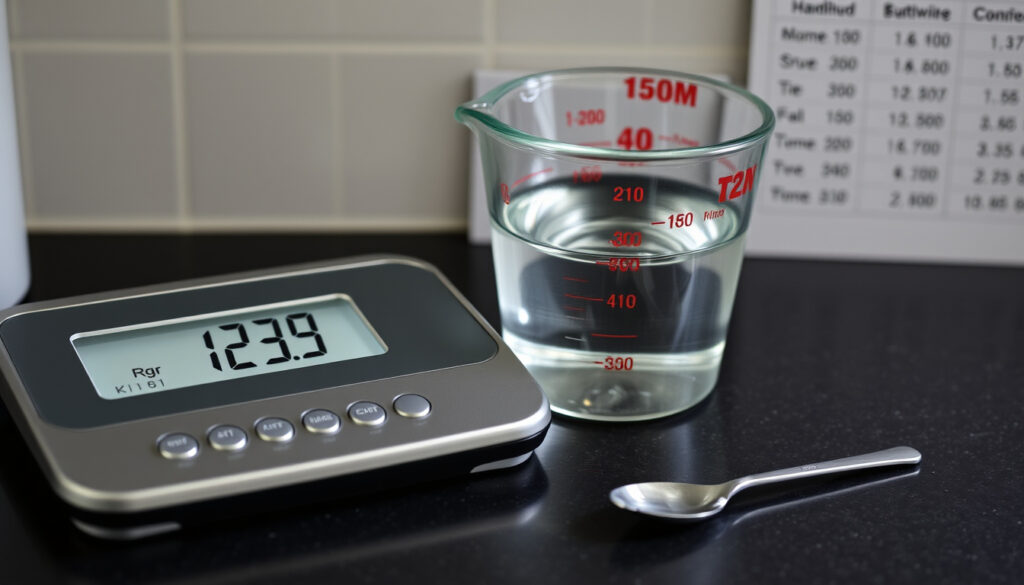
ml to Grams: How to Convert Milliliters to Grams Easily
Ever scooped flour into a measuring cup and wondered why your cake turned out dry? The assumption that 1 milliliter equals 1 gram is the root of countless baking mishaps, and this guide explains how density affects conversions.
Water density: 1 g/mL · Milk density: ~1.03 g/mL · Vegetable oil density: ~0.92 g/mL · All-purpose flour density: ~0.53 g/mL
Quick snapshot
- Water density is exactly 1 g/mL at 4°C (NIST (U.S. national standards body))
- Conversion formula: grams = milliliters × density (Lively Table (cooking resource))
- Exact flour density varies by brand, moisture, and sifting (King Arthur Baking (baker’s resource))
- Honey density depends on temperature and variety (ConvertX (conversion database))
- Water density standard adopted by NIST defines the baseline for all conversions (NIST (U.S. national standards body))
- Bookmark a density reference for common ingredients (ChefSteps (ingredient database))
This table summarizes the density and resulting weight for 250 mL of common ingredients.
| Ingredient | Density (g/mL) | 250 mL converts to |
|---|---|---|
| Water | 1.00 | 250 g |
| Milk | ~1.03 | ~257.5 g |
| All-purpose flour | ~0.53 | ~132.5 g |
| Vegetable oil | ~0.92 | ~230 g |
Is 1 mL Equal to 1 Gram?
The special case of water
Water is the only common substance where 1 milliliter equals exactly 1 gram — but only at 4°C, where it reaches its maximum density of 1.00 g/mL (NIST (U.S. national standards body)). At room temperature (20°C), water’s density shifts slightly to about 0.998 g/mL, but for everyday cooking the difference is negligible.
Why density matters for other substances
The fundamental conversion formula is: mass (grams) = volume (mL) × density (g/mL) (Lively Table (cooking resource)). Every ingredient has its own density. Milk, for example, has a density of about 1.03 g/mL because of its fat and protein content (ConvertX (conversion database)). Vegetable oil is less dense at roughly 0.92 g/mL (ConvertX (conversion database)).
Assuming water’s 1:1 ratio for oil means you’ll add 8% more mass than intended — enough to turn a delicate sponge cake into a grease puddle.
The implication: even small density differences can alter a recipe’s outcome.
How to Convert Milliliters to Grams
The basic formula: grams = milliliters × density
- Determine the volume in milliliters (mL).
- Find the density of the ingredient in grams per milliliter (g/mL).
- Multiply: weight (g) = volume (mL) × density (g/mL).
For example, 200 mL of milk (density 1.03 g/mL) gives 200 × 1.03 = 206 g.
Finding density for common ingredients
Density data is available from national databases and baking resources. The USDA FoodData Central (government nutrition database) lists densities for thousands of ingredients. King Arthur Baking (baker’s resource) publishes a weight chart that implies densities for common baking items.
Using a conversion calculator
Online tools like Omni Calculator (conversion tool) let you input volume and automatically look up density, but you still need to select the correct ingredient. For repeated baking, a kitchen scale eliminates the need for conversion entirely.
A home baker switching from volume to weight can cut recipe variability by up to 20% — the margin by which flour volume can change depending on how it’s scooped (Thermoworks (kitchen equipment expert)).
The pattern: volume measurement introduces hidden variability that weight eliminates.
Is 250 mL the Same as 250 Grams?
250 mL of water weighs 250 grams
Because water’s density is 1 g/mL, 250 mL × 1 g/mL = 250 g exactly (ConvertX (conversion database)). This is the only ingredient where volume and mass numbers match.
250 mL of milk weighs approximately 257.5 grams
Milk’s density of ~1.03 g/mL means 250 mL × 1.03 = 257.5 g. That extra 7.5 g can throw off a custard’s consistency if ignored.
250 mL of vegetable oil weighs about 230 grams
At 0.92 g/mL, 250 mL of vegetable oil gives 250 × 0.92 = 230 g. Using water’s 1:1 rule would over-oil your recipe by 20 grams — roughly a tablespoon extra.
What this means: assuming volume equals weight for any ingredient other than water introduces systematic error.
Why Does 250 mL of Flour Not Equal 250 Grams?
Flour density range (0.5–0.6 g/mL)
All-purpose flour has a density of approximately 0.53 g/mL (ConvertX (conversion database)). That means 250 mL of flour weighs about 132.5 g — barely half the 250 g a novice might expect. A standard US cup (236.6 mL) of flour converts to roughly 125 g (The Calculator Site (conversion resource)).
Impact of flour type and compaction
Flour density varies by type (bread, pastry, whole wheat), brand, and how it is scooped. Sifted flour can be 20% lighter than packed flour (King Arthur Baking (baker’s resource)). That’s why weight measurement is far more reliable for baking.
What Is the Difference Between 250 mL and 250 g in Baking?
Volume (mL) vs mass (g) – a fundamental distinction
Milliliters measure space; grams measure matter. They are interchangeable only when density is exactly 1 g/mL (Britannica (science encyclopedia)). For any other ingredient, assuming equivalence leads to systematic error.
Why professional bakers prefer weight
Baking is chemistry. A 10% error in flour can change crumb structure, hydration, and rise. Professional recipes almost always list ingredients by weight (Cooking Light (cooking technique resource)). A kitchen scale is the only way to replicate results batch after batch.
When to use each measurement
- Use mL for liquids that are mostly water (broth, juice, wine) – density is close enough to 1.
- Use grams for flour, sugar, butter, honey, and any ingredient where precision matters.
- For mixed recipes (liquids in mL, dry in g), convert everything to grams using ingredient densities.
Six common ingredients, one pattern: density differences that compound across a recipe. The table below shows how even small density shifts affect the weight of 250 mL.
| Ingredient | Density (g/mL) | 250 mL weight (g) | Deviation from water (g) |
|---|---|---|---|
| Water | 1.000 | 250.0 | — |
| Milk | 1.030 | 257.5 | +7.5 |
| Vegetable oil | 0.920 | 230.0 | -20.0 |
| All-purpose flour | 0.529 | 132.3 | -117.7 |
| Granulated sugar | 0.845 | 211.3 | -38.7 |
| Honey | 1.420 | 355.0 | +105.0 |
| Butter | 0.959 | 239.8 | -10.2 |
| Table salt | 1.217 | 304.3 | +54.3 |
Data from ConvertX (conversion database) and The Calculator Site (conversion resource).
The implication: a recipe calling for 250 mL of honey and 250 mL of flour cannot be mixed by volume alone — their weights differ by nearly 223 g. Converting each to grams is the only way to maintain the intended ratio.
Confirmed facts
- Water density = 1 g/mL at 4°C (NIST standard) (NIST (U.S. national standards body))
- Conversion formula: g = mL × density (Lively Table (cooking resource))
- Milk density ranges 1.027–1.035 g/mL (USDA FoodData Central (government nutrition database))
What’s unclear
- Exact flour density varies by brand, moisture content, and sifting (King Arthur Baking (baker’s resource))
- Density of honey depends on temperature and floral variety
“Accurate measurement is the foundation of consistent baking. Weight eliminates the guesswork of volume.”
— King Arthur Baking, ingredient weight chart (King Arthur Baking (baker’s resource))
“The kilogram, defined by the international prototype, provides the ultimate reference for mass measurements. Water at its maximum density provides the link to volume.”
— NIST, SI redefinition
Choosing volume over weight isn’t just a trade-off — it’s a gamble with consistency. For home bakers, the choice is clear: keep a kitchen scale handy, or risk inconsistent results every time. Weight measurement, supported by conversion charts and a density guide, is the only path to reliable baking.
Related reading: **Hot Cross Buns: Recipe, History, Origin & Traditions** · **Beef Bourguignon Recipe: Authentic Slow-Cooked French Classic**
Frequently asked questions
How many grams in 1 mL of honey?
At typical density of 1.42 g/mL, 1 mL of honey weighs approximately 1.42 g (ConvertX (conversion database)).
Can I use a measuring cup to convert ml to grams?
A measuring cup gives volume. To get weight, you need density. For water, it’s 1:1; for other ingredients, you must multiply by density.
What is the easiest way to convert ml to grams without a scale?
Use an online conversion tool like Omni Calculator that looks up density for you, but a cheap kitchen scale is more reliable and faster.
Is the conversion different for liquids vs dry ingredients?
No — the same formula applies: weight = volume × density. The difference is that liquids like water have predictable densities, while dry ingredients like flour can vary.
How do I convert 200 mL of yogurt to grams?
Yogurt density is roughly 1.04 g/mL, so 200 mL × 1.04 = 208 g. Check the label for exact density if available.
Does temperature affect ml to grams conversion?
Yes. Density changes with temperature (water expands when heated, becoming less dense). For most cooking, room temperature assumptions are adequate, but precise baking may need temperature-specific values.
Why do some recipes use ml for liquids and g for dry ingredients?
It’s convention: liquids (water, milk, oil) have densities close to 1, so volume is a good proxy. Dry ingredients vary widely, so weight is more reliable. For best results, convert all to weight.
More related posts
 Jelena Dokic: Tennis Career, Surgery, and Net Worth
 Jonas Brothers: Nick’s Diagnosis, Joe’s Divorce & Kevin’s Loss
 Cult of the Lamb: Age Rating, LGBTQ+ Characters, & More
 Woolworths West Ryde: Hours, Address, Phone & Online Shopping
 Colonel Sanders: KFC Founder, Real Name, Age, and Death
 Ali Khamenei: Religion, Death, Successor, and Full Biography
 Fernando Mendoza: Raiders QB stats, age, and future
 Harry Wilson: Transfer, Salary, Personal Life, and Career
