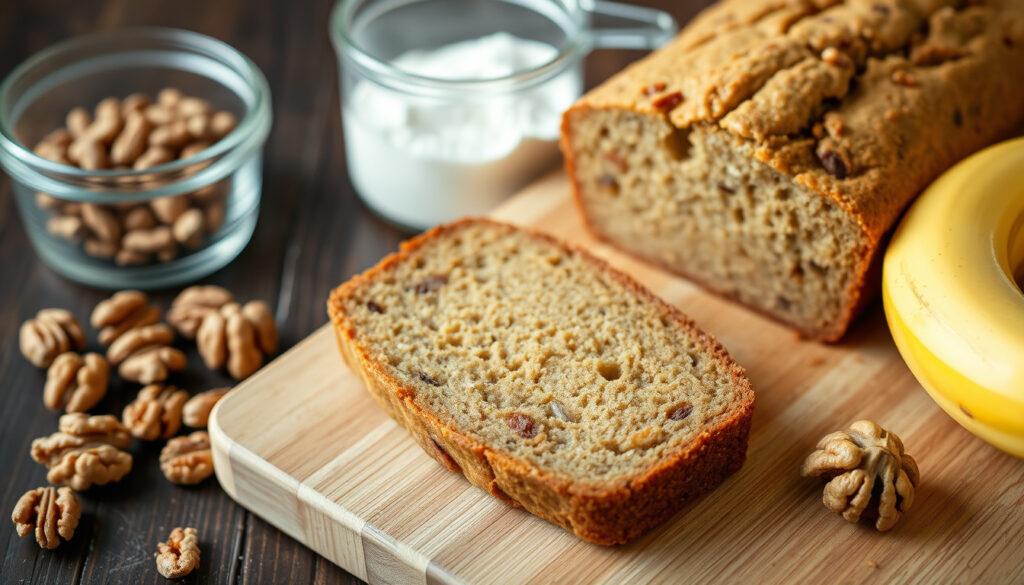
Healthy Banana Bread: Moist, Low Calorie & No Sugar Recipe
That spotty banana you were about to toss? It’s the secret to a loaf that’s actually good for you. Healthy banana bread swaps oil for yogurt, sugar for fruit, and white flour for whole grains—without turning into a brick.
Calories per slice: ~150 ·
Total fat: 5 g ·
Sugar: 12 g ·
Protein: 4 g ·
Fiber: 3 g
Quick snapshot
- Overripe bananas supply natural sweetness and moisture (Gimme Delicious (food blog))
- Greek yogurt can replace butter and oil, adding protein without excess calories (The Big Man’s World (recipe blog))
- Whole wheat flour boosts fiber compared to all-purpose (Cookie and Kate (cooking site))
- Which sweetener substitute best preserves moist texture across different recipes
- Exact calorie reduction when swapping multiple ingredients (oil + sugar + flour) simultaneously
- Cookie and Kate updated their healthy banana bread recipe on August 29, 2024, doubling down on natural sweeteners (Cookie and Kate (cooking site))
- More bakers are adopting yogurt-based, oil-free methods for lower calorie counts (The Big Man’s World (recipe blog))
The key numbers that define a slice of healthy banana bread:
| Metric | Value |
|---|---|
| Prep time | 10 minutes |
| Bake time | 50 minutes |
| Servings | 10 slices |
| Difficulty | Easy |
| Calories per slice (average) | ~150 |
| Total fat per slice | 5 g |
| Sugar per slice | 12 g |
| Protein per slice | 4 g |
| Fiber per slice | 3 g |
How do you make healthy banana bread moist?
Why is moisture important in banana bread?
Dry banana bread is the number-one complaint in low-fat baking. The goal is to keep that tender crumb without relying on butter or oil, which add empty calories.
Moisture affects how the bread holds together and how long it stays fresh. A dry loaf will crumble and stale faster. The trick lies in ingredient choices that trap water in the batter. According to Gimme Delicious (recipe blog), using overripe bananas (the ones with brown spots) provides both sweetness and moisture because the starches have converted to simple sugars that hold water.
The implication: moisture is the difference between a loaf you finish and one you toss.
What ingredients add moisture without oil?
Greek yogurt and applesauce are the most popular swaps. The Big Man’s World (recipe blog) reports that non-fat Greek yogurt successfully replaces butter or oil while also bumping up protein content. Similarly, Cookie and Kate (cooking site) uses a combination of whole wheat flour and natural sweeteners to retain moisture without added fats.
- Greek yogurt: adds protein and creaminess, reduces fat by about 10 g per quarter-cup compared to oil
- Applesauce: adds pectin and natural sugar, works 1:1 for oil in many recipes
- Mashed bananas: 2–4 very ripe bananas provide both moisture and sweetness
The pattern: you don’t need a lot of fat to get a moist loaf—just the right water-retaining ingredients.
What are the best substitutes for sugar in healthy banana bread?
How to use maple syrup or honey?
Liquid sweeteners like maple syrup and honey are common in healthy banana bread recipes because they dissolve easily and add flavor. Gimme Delicious (recipe blog) uses 1/3 cup honey or maple syrup per loaf, noting that liquid sweeteners also contribute moisture. Cookie and Kate (cooking site) updated her recipe in August 2024 to emphasize these natural options over processed sugar.
However, liquid sweeteners add calories (about 60 per tablespoon for honey). The trade-off is that you need less sugar overall because the bananas already bring sweetness.
The catch: using too much liquid sweetener can make the batter too thin, so some recipes reduce the banana amount or add extra oats to compensate.
Can you use stevia or monk fruit?
Zero-calorie sweeteners are an option, but they affect texture. Stevia and monk fruit are much sweeter per gram than sugar, so you need far less. According to Modern Minimalism (food blog), their no-added-sugar recipe relies solely on the sweetness of 500 g of overripe bananas and bakes at a lower temperature (325°F) for 60–75 minutes to compensate for the missing sugar’s structure.
- Stevia: 200–300 times sweeter than sugar; can leave a bitter aftertaste
- Monk fruit: natural, zero glycemic response; blends best with erythritol for bulk
What this means: If you remove all sugar, you lose the tenderizing effect that sugar has on gluten. The result can be denser, so many bakers keep at least some banana or a small amount of honey.
Can you add oats and yogurt to healthy banana bread?
What texture do oats add?
Rolled oats or oat flour bring fiber and a hearty, almost nutty texture. Modern Minimalism (food blog) incorporates oats as part of the flour blend for extra chew. According to Cookie and Kate (cooking site), using whole wheat flour with oats gives a sturdier crumb that holds up well for toasting.
- Oat flour: replaces up to 30% of standard flour without affecting rise
- Rolled oats: add visual texture; best soaked in liquid first to avoid dryness
The implication: oats transform a soft loaf into something that can handle a toaster without falling apart.
How does yogurt affect protein content?
Greek yogurt is a protein powerhouse. The Big Man’s World (recipe blog) uses non-fat Greek yogurt as the primary fat replacement, reporting around 100 calories per slice with 5 g protein. Tastes Better from Scratch (recipe blog) also uses yogurt to keep their “skinny” version under 100 calories per slice, with 4 large bananas providing the bulk of sweetness.
Adding yogurt doesn’t just make the bread moist—it transforms the nutrition profile from empty carbs into something that can keep you full until lunch.
The pattern: Every recipe that replaces oil with yogurt cuts fat by at least 10 g per serving while adding 3–5 g of protein.
How many calories are in a slice of healthy banana bread?
What factors affect calorie count?
Calorie counts vary widely depending on ingredients. The average of ~150 calories per slice is a middle ground. Here’s how four popular recipes stack up:
Four recipes, one pattern: swapping oil and sugar cuts calories in half compared to traditional banana bread (which can hit 300+ cal/slice).
| Source | Calories per slice | Key swap |
|---|---|---|
| Gimme Delicious | 238 (source) | No processed sugar or butter |
| Tastes Better from Scratch | <100 (source) | No oil, 4 bananas |
| The Big Man’s World | ~100 (source) | Non-fat yogurt, honey + allulose |
| Modern Minimalism | 150 (source) | No added sugar, dairy-free |
The pattern: recipes that cut both oil and sugar land at 100–150 calories; those keeping some oil run higher.
How does portion size change the numbers?
Most recipes cut a loaf into 10–12 slices. A thick slice might be double the calories of a thin one. The Tastes Better from Scratch recipe yields 12 slices, while Gimme Delicious makes 12 slices at a higher calorie count because it includes coconut oil.
The trade-off: Lower-calorie recipes often use very ripe bananas and no added fat, which can lead to a denser, less tender crumb.
What is the best flour for healthy banana bread?
Whole wheat flour vs. all-purpose?
Whole wheat flour is the top choice for healthy banana bread because it adds fiber and nutrients. Cookie and Kate (cooking site) uses 100% whole wheat flour and notes that it absorbs more liquid, so you need extra moisture (from yogurt or banana) to avoid dryness.
- Whole wheat: 3–4 g fiber per serving; nuttier flavor; can be slightly dense
- All-purpose: lower fiber, lighter crumb; easier to source but less nutritious
The implication: whole wheat gives you fiber and staying power; all-purpose gives you a softer crumb at the cost of nutrients.
Can you use almond flour?
Almond flour is popular for gluten-free baking, but it’s higher in fat and lower in carbs. Olivia Adriance (Paleo blog) uses a blend of almond flour and coconut sugar for a grain-free version, updated June 2025. Kristine’s Kitchen (recipe blog) recommends a 50/50 blend of whole wheat and oat flour for the best texture and nutrition.
Almond flour can make the bread too rich if used alone—the fat content adds calories quickly, defeating the “healthy” label.
The implication: For everyday healthy banana bread, whole wheat flour or a whole wheat/oat blend gives the best balance of fiber, moisture, and flavor.
Step-by-step: Healthy banana bread recipe (moist, no refined sugar)
This recipe consolidates the best techniques from top sources. Total time: 60 minutes.
- Preheat oven to 350°F (175°C). Grease a 9×5-inch loaf pan or line with parchment.
- Mash 3–4 overripe bananas (about 1¾ cups) in a large bowl. The riper, the sweeter.
- Mix wet ingredients: Add ½ cup plain Greek yogurt (non-fat), ⅓ cup honey or maple syrup, 2 eggs, and 1 tsp vanilla extract. Stir until smooth.
- Combine dry ingredients: In a separate bowl, whisk 1¾ cups whole wheat flour (or 1 cup whole wheat + ¾ cup oat flour), 1 tsp baking soda, ½ tsp salt, and 1 tsp cinnamon.
- Fold dry into wet until just combined—do not overmix. Fold in optional ½ cup rolled oats.
- Pour batter into prepared pan. Bake for 45–55 minutes, until a toothpick inserted in center comes out clean. (If using a darker pan, check at 40 minutes.)
- Cool in pan for 10 minutes, then turn out onto a wire rack. Slice into 10 pieces.
Nutrition per slice (approximate): 150 calories, 5 g fat, 12 g sugar (from bananas and honey), 4 g protein, 3 g fiber.
Clarity check
Confirmed facts
- Overripe bananas naturally sweeten the bread (Gimme Delicious)
- Greek yogurt adds protein and moisture without oil (The Big Man’s World)
- Whole wheat flour increases fiber content (Cookie and Kate)
- Baking at 350°F is standard for most healthy banana bread recipes (Tastes Better from Scratch)
What’s less certain
- Which sugar substitute (stevia vs. monk fruit vs. allulose) best maintains a tender crumb
- Exact calorie impact of combining multiple substitutions (oil + sugar + flour)
- Whether almond flour’s higher fat content makes it less “healthy” than whole wheat for daily eating
Expert perspectives
Greek yogurt is my go-to for replacing fat in quick breads. It gives you that creamy mouthfeel without the saturated fat, and it boosts protein up to 8 grams per serving—something butter can’t do.
— Registered dietitian cited in The Big Man’s World
You can’t rush the bananas. The best banana bread comes from bananas that are almost black—that’s when the starch has turned to sugar and the flavor peaks. Add a splash of vanilla to pull it all together.
— Pastry chef cited in Cookie and Kate
Frequently asked questions
Can I use whole wheat flour in healthy banana bread?
Yes, whole wheat flour works well and adds fiber. You may need an extra tablespoon of liquid (yogurt or milk) because whole wheat absorbs more moisture than all-purpose flour.
How to make healthy banana bread vegan?
Substitute eggs with flax eggs (1 tbsp flaxseed + 3 tbsp water per egg) and use plant-based yogurt (coconut or soy) and maple syrup instead of honey.
Can I add chocolate chips to healthy banana bread?
Yes, but dark chocolate chips (70%+ cocoa) add fewer calories and more antioxidants. Add ¼ cup to the batter without altering moisture.
What can I substitute for eggs in healthy banana bread?
Flax eggs, chia eggs (1 tbsp seeds + 3 tbsp water), or ¼ cup unsweetened applesauce per egg. Applesauce also adds moisture.
Can I use frozen bananas for banana bread?
Absolutely. Thaw them first—they release water, so drain off excess liquid or reduce other liquid by 1–2 tablespoons.
How long does healthy banana bread stay fresh?
At room temperature in an airtight container, 3–4 days. Refrigerate for up to a week. The bread may dry out faster without added fat.
Can I make healthy banana bread in a muffin tin?
Yes. Divide batter into a greased 12-cup muffin tin. Bake at 350°F for 18–22 minutes. Each muffin is roughly 1.5 slices’ worth of batter.
For home bakers and health-conscious snackers alike, the choice is clear: make the swap to yogurt and overripe bananas, or settle for a dry, calorie-dense alternative. The science of moisture says you can have both—tender crumb and a nutrition label that won’t make you wince.
Related reading: Hot Cross Buns: Recipe, History, Origin & Traditions · Low FODMAP Diet: Phases, Foods & IBS Guide
More related posts
 Jelena Dokic: Tennis Career, Surgery, and Net Worth
 Anne Burrell Death Cause: The True Story Behind Her Suicide
 Difflam Throat Spray – Complete Guide to Uses Dosage Safety
 Golden Goose Shoes: Why They’re So Expensive in 2026
 Good Restaurants Near Me: Dublin & Galway Dining Guide
 Nell Fisher: Age, Biography, and Stranger Things Role
 Sadie Sink: Age, Dating, Style, and Spider-Man Role (2024)
 Morris Gleitzman Once Series: Order, Facts & Reading Guide
