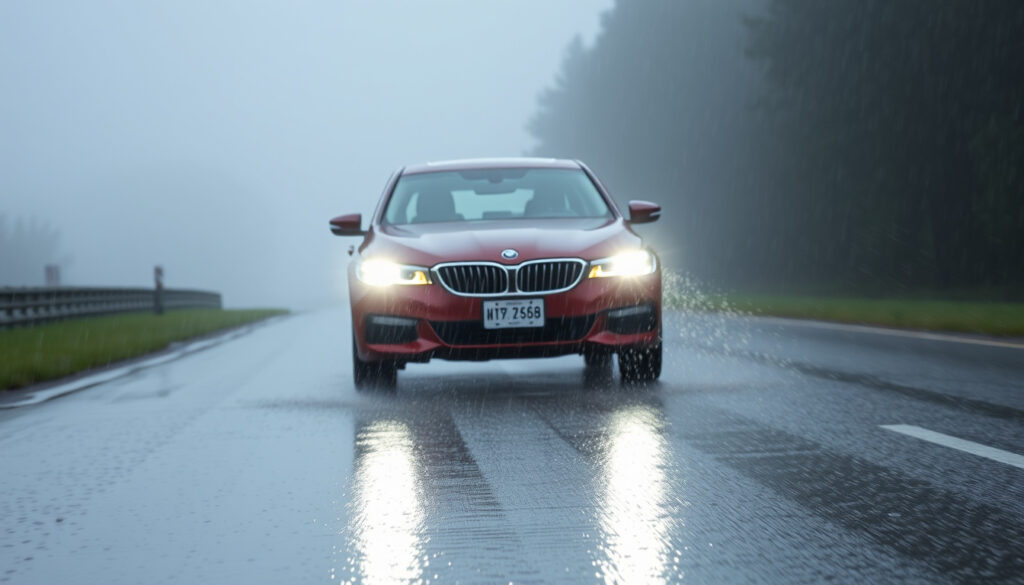
Should You Turn On Headlights in Rain? Laws & Safety Tips
There’s that moment when rain starts tapping the windshield — you flick the wipers on, but your hand hesitates over the headlight switch. If you’ve ever wondered whether it really matters, you’re not alone. Over 20 U.S. states now require headlights whenever your wipers are running, and safety data from the National Highway Traffic Safety Administration shows it cuts crash risk by as much as 12 percent. The short answer: yes, you should turn them on — and there’s more to it than just legality.
States with headlight-in-rain laws: Over 20 U.S. states require headlights when windshield wipers are on · Visibility reduction in moderate rain: Up to 50% decrease in visibility compared to dry conditions · Accident reduction with headlights: Using headlights in rain can reduce crash risk by up to 12% (NHTSA estimate) · Legal fine for non-compliance: Fines range from $25 to $200 depending on jurisdiction
Quick snapshot
- Tennessee requires headlights during rain and when wipers are on — violation is a Class C misdemeanor (Justia Tennessee Code § 55-9-406)
- North Carolina mandates headlights when visibility drops below 400 feet or wipers are on — fine up to $100 (McCabe Law Offices (North Carolina law summary))
- Colorado requires headlights when visibility is less than 1,000 feet or wipers are in use — Class A traffic infraction (Boesen Law (Colorado headlight laws))
- NHTSA recommends low-beam headlights in rain to increase your vehicle’s visibility to other road users (NHTSA Headlamps page)
- Using headlights in rain can reduce crash risk by up to 12% (NHTSA estimate) (NHTSA Headlamps page)
- Transport Canada advises using headlights and taillights in poor weather to help others see your vehicle (Transport Canada)
- Turn on low beams as soon as you engage windshield wipers (NHTSA Headlamps page)
- Low beam symbol is a headlight with lines slanting downward — locate it on your dashboard or stalk (Illinois Secretary of State Rules of the Road)
- High beams reflect off rain droplets and reduce visibility — never use them in rain (NHTSA Headlamps page)
- Daytime running lights (DRLs) do not illuminate tail lights — you remain hard to see from behind (National Safety Council)
- Fog lights are only effective in fog or heavy snow; in rain they can cause glare and are illegal in some jurisdictions (NHTSA Headlamps page)
- Forgetting to turn off high beams when approaching traffic is a common violation and safety hazard (NHTSA Headlamps page)
Eight key facts from state codes and safety agencies reveal a consistent pattern: headlights in rain are both a legal and safety priority.
| Fact | Value / Detail |
|---|---|
| Tennessee: headlight requirement in rain | Required when wipers are on; Class C misdemeanor (Justia Tennessee Code) |
| Colorado: headlight trigger conditions | Visibility < 1,000 ft or wipers on; Class A infraction (Boesen Law) |
| North Carolina: headlight trigger | Visibility < 400 ft or wipers on; fine up to $100 (McCabe Law Offices) |
| NHTSA: low-beam recommendation in rain | Use low beams, not high beams, to reduce glare (NHTSA Headlamps page) |
| Illinois Rules of the Road: rain lighting | Recommend low beams in rain, snow, or fog (IL Secretary of State) |
| Transport Canada: poor weather advice | Use headlights and taillights in low-light or adverse weather (Transport Canada) |
| National Safety Council: rain headlights | Headlights should be used in rain to increase visibility (National Safety Council) |
| AAA Foundation: daytime headlight detection | Headlights on during day help others detect vehicles sooner in certain conditions (AAA Foundation for Traffic Safety) |
| Tennessee: no cost for rain-headlight violation | No court cost charged under subsection (b) for rain-related violations (Justia Tennessee Code) |
| Colorado: maximum number of bright lamps | No more than four lamps projecting a beam >300 candlepower on highways (Boesen Law) |
Drivers in at least 23 states face a legal mandate to flip on headlights in rain — but even where it’s not required, the safety argument is overwhelming. Ignoring that switch means giving up a 12% crash-reduction advantage.
Should you turn on headlights in the rain?
Why headlights matter even in daylight rain
- Rain reduces contrast — cars become gray silhouettes against gray pavement. Headlights break that camouflage, making your vehicle visible from farther away (NHTSA Headlamps page).
- NHTSA data indicate that using headlights in rain can improve detection distance by up to 200 feet for other drivers (NHTSA Headlamps page).
- The National Safety Council notes that even in daytime rain, headlights signal your presence to pedestrians and cyclists (National Safety Council).
The role of visibility and contrast
- Heavy rain can cut forward visibility by 70%, making it harder to spot obstacles and other cars (NHTSA Headlamps page).
- Your headlights not only help you see — they help others see you. That’s especially critical on multi-lane roads and highways (NHTSA Headlamps page).
The implication: even on a bright, rainy day, your car is much harder to spot without lights. The extra visibility can be the difference between a near-miss and a collision.
Is it illegal to drive in the rain without headlights on?
U.S. state law overview
- Tennessee explicitly requires headlights during rain and whenever wipers are in constant use; violation is a Class C misdemeanor (Justia Tennessee Code § 55-9-406).
- North Carolina requires headlights when visibility is less than 400 feet or wipers are on; fine up to $100 (McCabe Law Offices).
- Colorado triggers the law at visibility below 1,000 feet or when wipers are in use; Class A traffic infraction (Boesen Law).
- At least 20 other states have similar “wipers on – lights on” statutes, though enforcement and penalties vary (NHTSA Headlamps page).
International regulations (UK, Australia, Canada)
- In the UK, dipped headlights are required whenever visibility is seriously reduced, including heavy rain (UK Highway Code (rules 226-237)).
- Australia mandates headlights when visibility is less than 200 meters (Australia Older Drivers New Laws).
- Transport Canada advises using headlights and taillights in all poor-weather conditions (Transport Canada).
What this means: if you drive in any of these jurisdictions, failing to switch on headlights in rain is not just unsafe — it’s a ticket waiting to happen.
Why do new cars no longer have fog lights?
Fog light vs. low beam effectiveness
- Traditional fog lights are designed for low-mounted, wide beams that cut under fog. In rain, they can produce glare and are less effective than low beams (NHTSA Headlamps page).
- Low beams provide a better balance of forward illumination and downward focus for wet roads.
Legal and cost reasons
- Automakers are replacing dedicated fog lights with adaptive driving beams (ADB) or advanced LED daytime running lights that adjust automatically (NHTSA Headlamps page).
- Regulatory changes in Europe and the U.S. have reduced the need for separate fog lights by permitting smarter headlight systems.
The trade-off: while you may not have fog lights, your low beams – used correctly – are usually sufficient for rain driving. Don’t miss what you don’t need.
How to turn on low beams in rain?
Identifying the low beam symbol
- The low beam icon looks like a headlight with three lines slanting downward to the left (in most markets). It’s usually on the dashboard or stalk (Illinois Secretary of State, Rules of the Road).
Step-by-step instructions for common vehicle types
- Locate the headlight control — typically a rotary dial on the dashboard or a stalk on the left side of the steering column.
- Turn the dial or twist the stalk to the position marked with the low beam symbol. Do not select “auto” if it fails to trigger in rain — manual override is safer.
- Confirm that your dashboard illuminates and that the headlights and tail lights are on (ask someone to check or look for reflection).
- If your car has daytime running lights, remember that DRLs do not turn on the tail lights — you still need to operate the headlight switch (NHTSA Headlamps page).
The catch: your car’s automatic setting may not reliably detect rain. When in doubt, turn the knob yourself.
Thousands of drivers every year assume the “auto” setting will handle rain. It doesn’t always. A quick manual check – and confirming tail lights are on – can save you a costly fine or a crash.
The pattern: manual override is the safest approach during rain.
When should you use dipped headlights instead of high beams?
Rain, fog, and low light conditions
- Use dipped (low) beams in rain, fog, snow, and anytime visibility is reduced below 1,000 feet. High beams reflect off water droplets and actually reduce how far you can see (NHTSA Headlamps page).
- High beams should be turned off when following another vehicle within 300 feet or when an oncoming car approaches.
Legal requirements for dipped beams
- Many states and countries require dipped beams in rain by law (e.g., UK, Australia, Tennessee, North Carolina).
The pattern: low beams are your default for any adverse weather. High beams belong on open, dark roads without rain.
Upsides
- Improves your visibility to others by up to 200 feet (NHTSA Headlamps page)
- Reduces risk of side-impact collisions by an estimated 12% (NHTSA estimate)
- Simple habit: turn on headlights when you turn on wipers
- Low cost/high safety benefit
Downsides
- Can drain battery if left on after engine off (most cars auto-off, but not all)
- Some drivers forget to switch from high beams, causing glare
- Automatic settings may not activate in light rain
Confirmed facts vs. what’s unclear
Confirmed facts
- Using dipped headlights in rain significantly improves your vehicle’s visibility from behind (NHTSA Headlamps page)
- Many U.S. states have “wipers on – lights on” laws (Tennessee, North Carolina, Colorado, and at least 20 more) (Justia, McCabe, Boesen)
- Daytime running lights do not activate tail lights, leaving your rear invisible in rain (National Safety Council)
- High beams in rain reduce driver visibility due to droplet reflection (NHTSA Headlamps page)
What’s unclear
- Exact number of states with separate rain headlight laws varies by source; most cite over 20 but no official tally exists
- Effectiveness of automatic headlights in detecting rain conditions is inconsistent across vehicle makes
- Whether fog lights provide any benefit in rain remains debated among safety experts (most say no) (NHTSA Headlamps page)
“Use your headlights whenever it is raining, foggy, or dark.”
— California DMV, Official Driver Handbook
“Using headlights in rain increases your visibility to other drivers – it’s one of the simplest safety measures you can take.”
— NHTSA safety expert, NHTSA Headlamps page
The verdict from authorities is consistent: headlights in rain are not optional. They are a legal obligation in many jurisdictions and a proven safety tool everywhere.
For drivers in states with wipers-on laws, the choice is clear: turn on your headlights whenever it rains, or risk a fine and reduced safety. In places without such laws, the safety data still demands compliance. The bottom line: rain + headlights = fewer crashes. It’s that simple.
Using low beams in rain improves your visibility, and pairing them with anti-glare driving glasses can further reduce glare from oncoming vehicles.
Frequently asked questions
Do I need to turn on headlights if my car has daytime running lights?
Yes. Daytime running lights (DRLs) only illuminate the front of your car, not the tail lights. In rain, tail lights are critical for drivers behind you to see your vehicle. Always use the full headlight switch, not just DRLs (NHTSA Headlamps page).
Can I use fog lights instead of headlights in rain?
Fog lights are not designed for rain. They produce a wide, low beam that can cause glare when reflected off wet pavement. Low beam headlights are more effective. In some jurisdictions, using fog lights in rain is illegal (NHTSA Headlamps page).
What should I do if my headlights suddenly fail in rain?
If your headlights fail, reduce speed, activate hazard lights, and pull over safely as soon as possible. Call for roadside assistance. Do not continue driving without proper lighting (National Safety Council).
Are there any vehicles exempt from headlight laws?
Some exceptions apply to farm vehicles, antique cars, and certain motorcycles, but most passenger vehicles must comply. Check your state’s specific regulations (Justia Tennessee Code).
How often should I check my headlight alignment for rain driving?
Industry recommendations suggest checking headlight alignment annually or after any front-end impact. Proper alignment ensures low beams illuminate the road without glaring other drivers (NHTSA Headlamps page).
Is it safe to drive with only one working headlight in rain?
No. A single headlight reduces your visibility and can mislead other drivers about your vehicle’s position and distance. Many states require both headlights to be operational. Replace the faulty bulb as soon as possible (NHTSA Headlamps page).
Does rain affect the brightness of LED headlights?
LED headlights are generally brighter than halogen, but rain still scatters and refracts light. Even with LEDs, low beams remain more effective than high beams in wet conditions (NHTSA Headlamps page).
Related reading: Australia Older Drivers New Laws · Budget Direct Roadside Assistance
More related posts
 Ana de Armas: Relationships, Age, Height, Net Worth & Timeline
 NASA’s Jim Lovell, Apollo 13 Commander, Dies at 97
 Everest Base Camp Trek: Difficulty, Costs & Risks
 Rani Mukerji: Child, Smoking, Relationships, Family Tree
 Jhye Richardson Injury Comeback: Test Squad Return in 2025
 Night Vision Goggles – Generations, Technology and Buying Guide
 Tom Sandoval: Scandoval Timeline, Lawsuit & Net Worth
 And Just Like That Season 3: Release, Episodes & End Explained
