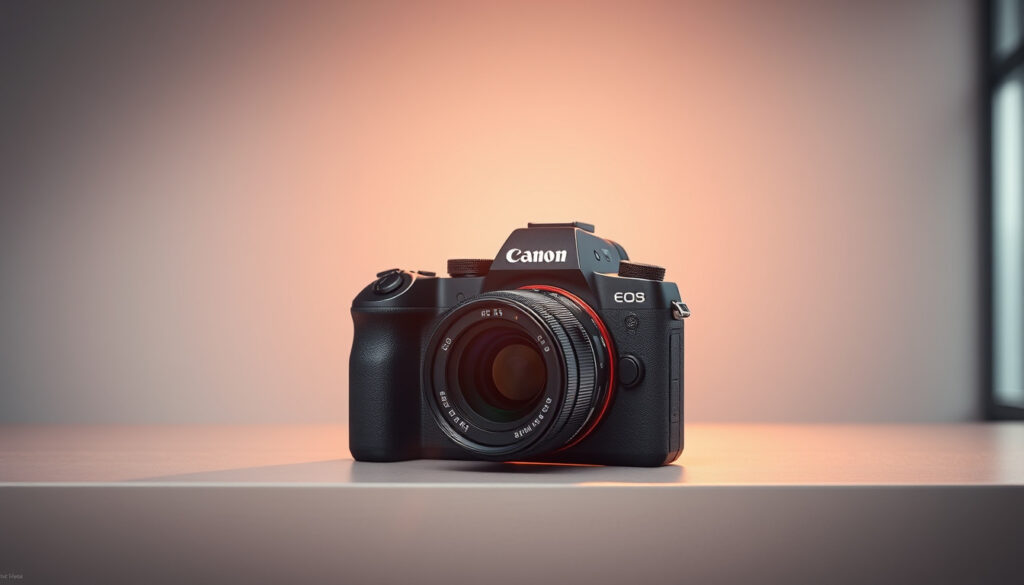
Canon EOS R8 – Full-Frame Mirrorless Camera Guide
The Canon EOS R8 positions itself as an accessible gateway to full-frame mirrorless photography. Announced in February 2023 and shipping the following month, this compact body delivers the same 24.2-megapixel sensor and Dual Pixel CMOS AF II system found in Canon’s higher-end models, making advanced autofocus capabilities available at a more approachable price point.
Weighing just over 400 grams, the R8 represents Canon’s strategy of bringing full-frame image quality to photographers who prioritize portability. The camera captures 4K video oversampled from 6K, offers burst shooting up to 40 frames per second with its electronic shutter, and includes 10-bit C-Log 3 recording for post-production flexibility.
24.2MP Full-Frame CMOS
~$1,499 body-only
February 2023
40fps burst shooting
What Are the Key Specs of the Canon EOS R8?
The Canon EOS R8 shares critical imaging components with Canon’s more expensive models while making deliberate compromises to reach its price point. Understanding these specifications helps potential buyers assess whether this camera meets their creative needs.
Key insights about the Canon EOS R8:
- Identical 24.2MP sensor to the R6 II, delivering comparable image quality at a lower cost
- Full-frame coverage without APS-C crop, maximizing lens compatibility
- Electronic shutter enables 40fps continuous shooting for action and wildlife
- Vari-angle touchscreen simplifies vlogging and low-angle photography
- Weather sealing protects against moisture and dust during outdoor use
- Lacks in-body image stabilization, relying solely on lens-based stabilization
| Feature | Specification |
|---|---|
| Sensor | 24.2MP full-frame CMOS |
| ISO Range | 100-102,400 (expandable) |
| Video | 4K 60p (6K oversampled), 1080p 180fps |
| Battery Life | ~370 shots (CIPA) |
| Weight | 414-461g body only |
| Storage | Single UHS-II SD slot |
Canon EOS R8 vs Canon EOS R6 II: Key Differences
The R8 and R6 II share the same sensor and autofocus architecture, yet their differences extend across build quality, durability features, and handling characteristics. These distinctions determine which camera suits specific use cases.
Build and Handling
The R6 II features a more robust magnesium alloy body with extensive weather sealing compared to the R8’s polycarbonate construction. The R6 II includes a dedicated joystick for AF point positioning, while R8 users navigate using the touchscreen or rear dial—a workable but less intuitive approach during fast-paced shooting scenarios. Dual card slots on the R6 II provide redundant storage, a critical feature for professional assignments where data loss proves unacceptable.
Performance Differences
Both cameras match each other in burst rate and video resolution, with the R6 II adding in-body image stabilization that the R8 omits entirely. This absence of IBIS means R8 users must rely on lenses with optical stabilization or accept reduced handheld performance in low-light situations. Battery endurance also favors the R6 II significantly—approximately 580 shots versus 370 for the R8, according to CIPA testing.
When comparing these cameras, consider whether the R6 II’s IBIS, dual slots, and extended battery justify the $1,000 price premium for your specific workflow.
Canon R8 vs RP: Entry-Level Full-Frame Comparison
Canon positions the R8 above the older RP in its lineup hierarchy. The R8 delivers substantially faster autofocus, higher burst rates (40fps versus 5fps), and 4K 60p video capability where the RP maxes out at 4K 24p. Image quality benefits from Canon’s newer sensor technology, offering improved dynamic range and low-light performance. The $200-500 price difference reflects meaningful technological advancement rather than incremental refinement.
Is the Canon EOS R8 Good for Video and Performance?
The Canon EOS R8 emerged as a capable hybrid camera for creators who split their time between stills and video. Its video specifications read impressively on paper, but real-world performance reveals both strengths and limitations worth understanding before purchase.
Video Capabilities
Uncropped 4K 60p footage sampled from 6K delivers sharp, detailed video suitable for professional output. The inclusion of 10-bit C-Log 3 provides approximately 12 stops of dynamic range for color grading flexibility. Full HD capture at 180fps enables smooth slow-motion sequences for dramatic effect. Recording extends to approximately two hours before thermal throttling activates—a meaningful improvement over the 30-minute industry standard.
Battery Life in Practice
The LP-E17 battery delivers roughly 370 shots per charge under standard CIPA testing conditions. Real-world usage with frequent autofocus activation, live view operation, and video recording depletes the battery more rapidly. Photographers planning extended shoots should budget for additional batteries or a grip extension. For travel and casual use, the battery capacity typically proves adequate with mindful power management.
Independent reviewers consistently report faster-than-expected battery depletion during video recording and continuous autofocus use. Carrying two or three spare batteries provides comfortable shooting margins for most scenarios.
Autofocus Performance
Dual Pixel CMOS AF II with 1053 focus points covers approximately 100% of the frame horizontally and 90% vertically. Subject detection encompasses people, animals, and vehicles, automatically maintaining focus on eyes and faces during tracking. Low-light accuracy extends to approximately -6.5 EV with an f/1.2 lens attached, enabling reliable autofocus in challenging lighting conditions that challenge many competitors.
Image Quality Assessment
Reviewers consistently describe the R8 as a “low-light monster,” praising its wide dynamic range and controlled noise at elevated ISO settings. The non-stacked, non-BSI sensor prioritizes cost efficiency over readout speed, but the resulting image quality rivals more expensive cameras in this metric. High-ISO performance remains clean through ISO 6400, with acceptable results extending to ISO 12800 in emergency situations.
Canon EOS R8 Price and Is It Worth Buying?
The Canon EOS R8 launched at $1,499 for the body only, with kit options pairing the camera with the RF 24-50mm lens at $1,699. By 2024, street prices frequently dropped to approximately $1,300, representing strong value for photographers seeking full-frame capabilities without full-frame costs.
Market Position
Canon positioned the R8 between the aging RP (~$1,000) and the R6 II ($2,499). This placement creates a meaningful tier separation based on features rather than forcing buyers to choose between budget constraints and modern technology. The R8 delivers core imaging performance matching Canon’s professional tier while removing specialized features that appeal primarily to working photographers.
Value Assessment
For beginners entering full-frame photography, the R8 offers an compelling balance of capability and cost. The same sensor found in cameras costing $1,000 more means image quality remains indistinguishable in most shooting scenarios. Hybrid shooters benefit from 4K 60p video without the crop penalties present on some competitors. Travel photographers appreciate the lightweight build, though battery limitations require planning.
The R8 delivers strong value at current discounted prices around $1,300. Buyers requiring IBIS, extended battery life, or professional build quality should consider stepping up to the R6 II despite its higher cost.
Best Lenses for Canon EOS R8
The R8 performs best when paired with lenses matching its lightweight, versatile character. Canon’s RF mount ecosystem offers options ranging from budget-friendly primes to professional zoom lenses, with several models particularly well-suited to this camera’s strengths.
- RF 16mm f/2.8 ($299): Ultra-wide prime ideal for architecture, landscapes, and astrophotography in a compact package
- RF 50mm f/1.8 ($199): Versatile standard lens for portraits and low-light photography at an accessible price
- RF 24mm f/1.8 ($599): Macro-capable wide prime offering close focusing distance for product and detail photography
- RF 24-50mm f/4.5-6.3 IS ($200 kit premium): Basic zoom with built-in stabilization, providing everyday versatility
Full-frame coverage ensures every RF lens delivers its intended field of view without crop factor penalties. The absence of IBIS increases reliance on lens-based stabilization, making stabilized lenses particularly valuable for handheld shooting scenarios.
When Was the Canon EOS R8 Released?
The Canon EOS R8 arrived following a structured launch timeline typical of Canon’s product announcements. Understanding this sequence helps contextualize the camera’s market positioning and competitive landscape.
- February 2023: Canon officially announced the EOS R8 alongside the APS-C R50, signaling commitment to accessible mirrorless options across sensor sizes
- March 2023: Initial shipments reached retailers and early adopters, with availability expanding through spring
- 2023-2024: Price reductions brought the camera to approximately $1,300, increasing accessibility for budget-conscious buyers
What Is Confirmed vs Unclear About the Canon EOS R8?
Transparency about what manufacturers and reviewers have verified versus what remains uncertain helps readers form accurate expectations. Several aspects of the R8 have clear documentation while others warrant continued observation.
| Confirmed by Canon and Reviews | Information That Remains Unclear |
|---|---|
| 24.2MP sensor shared with R6 II | Specific firmware update roadmap |
| No in-body image stabilization | Long-term reliability data |
| 40fps electronic shutter burst | Successor model plans |
| 4K 60p uncropped video | Regional pricing variations |
| Single UHS-II card slot | Complete lens roadmap for RF mount |
Who Is the Canon EOS R8 For?
The Canon EOS R8 targets photographers and videographers seeking full-frame capabilities without professional-tier prices or weight. Its compact dimensions and lightweight construction make it particularly suitable for travel, street photography, and everyday documentation. The camera performs reliably for vlogging and content creation when paired with appropriate stabilization.
Beginners upgrading from smartphones or compact cameras benefit from the R8’s automatic shooting modes alongside manual controls that grow with their skills. Enthusiast photographers already invested in Canon’s RF ecosystem find the R8 serves as a capable secondary body. Professional users might consider the R8 as a lightweight backup for situations where larger cameras prove impractical.
What Do Reviews Say About the Canon EOS R8?
“Low-light monster with wide dynamic range, low noise at high ISO; matches R6 II in stills.” — Multiple independent reviews
Independent assessments consistently praise the R8’s value proposition, with reviewers noting that image quality rivals cameras costing significantly more. The autofocus system receives particular commendation for accuracy and subject detection capabilities that previously required higher-end hardware.
“Extremely high accuracy in low light; multi-subject detection rivals pro models.” — Stephen Knight Photography review
Constructive criticism focuses on the absence of in-body stabilization as the primary compromise, with secondary concerns about battery life and single card slot limitations. Overall ratings cluster around 8 out of 10, reflecting strong performance relative to price with acknowledged trade-offs.
Final Thoughts on the Canon EOS R8
The Canon EOS R8 successfully democratizes full-frame photography without sacrificing core imaging performance. Its shared sensor and autofocus technology with more expensive models deliver professional-grade results in a compact, affordable package. While the lack of IBIS and modest battery life represent genuine limitations, neither proves disqualifying for the camera’s intended audience. At current discounted prices approaching $1,300, the R8 offers exceptional value for photographers prioritizing image quality and modern autofocus over professional-grade build and features.
Frequently Asked Questions
When was the Canon EOS R8 released?
Canon announced the EOS R8 in February 2023, with retail availability beginning in March 2023.
Is the Canon EOS R8 full frame?
Yes, the R8 features a full-frame 24.2-megapixel CMOS sensor, the same imaging chip found in the more expensive R6 II.
Does the Canon EOS R8 have IBIS?
No, the R8 lacks in-body image stabilization. Stabilization depends entirely on lens-based optical stabilization systems.
How much does the Canon EOS R8 cost?
The R8 launched at $1,499 body-only, with street prices frequently reaching approximately $1,300 by 2024.
What is the battery life of the Canon EOS R8?
The LP-E17 battery delivers approximately 370 shots per charge under CIPA testing conditions, with faster depletion during video and autofocus-heavy use.
Can the Canon EOS R8 record 4K video?
Yes, the R8 captures uncropped 4K at 60fps, oversampled from 6K for enhanced detail, with 10-bit C-Log 3 for color grading flexibility.
What memory cards does the Canon EOS R8 use?
The R8 features a single UHS-II SD card slot, supporting fast write speeds for high-resolution photo and video capture.
How does the Canon EOS R8 compare to the Sony A7C II?
The R8 offers faster burst shooting (40fps versus 10fps) and typically lower pricing, but lacks the A7C II’s in-body stabilization and higher-resolution sensor.
More related posts
 ASICS GEL-KAYANO 2025: Who Should Wear It & How It Compares
 Amazon Promo Codes: How to Find & Use Them (2026 Guide)
 Cody Simpson 2025: Swimming, Miley, and the Net Worth Truth
 Dylan Sprouse: Net Worth, Wife, and Life After Disney
 David Jones Macquarie – Store Hours, Location and Guide
 Westpac Contact Number: How to Call from Australia & Overseas
 St. Sebastian: Patron of Soldiers, Athletes, and More
 Amy Adams: Biography, Children, Ethnicity, Movies & FAQs
