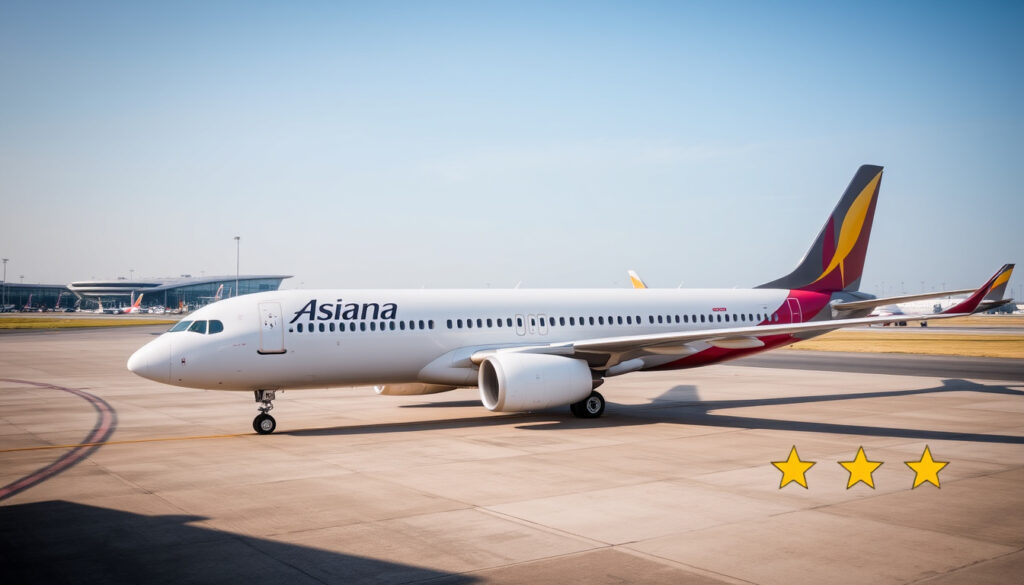
Asiana Airlines: Ownership, Safety, and 5-Star Rating
Anyone who has stepped onto an Asiana Airlines flight knows that the cabin crew’s bow is not just a greeting — it’s a signature of service that has earned the carrier a 5-Star rating from Skytrax. But beneath that polished surface lies a story of merger negotiations, a tragic crash, and a safety record that demands scrutiny.
Founded: 1988 ·
Fleet Size: 83 (2024) ·
International Destinations: 90+ ·
Skytrax Rating: 5-Star ·
Fatal Accidents: 1 (2013)
Quick snapshot
- Asiana is a 5-Star Skytrax airline (Skytrax Ratings)
- Owned by Kumho Industrial; Korean Air is the largest shareholder (Wikipedia)
- 3 deaths in Asiana Flight 214 crash (Wikipedia)
- Founded in 1988 (Skytrax Ratings)
- Future merger with Korean Air pending regulatory approval (Nikkei Asia)
- Integration timeline for full operational merger remains unclear (Nikkei Asia)
- The long-term impact on Asiana’s brand and service quality after merger is unknown (Nikkei Asia)
- Korean Air acquisition completed December 2024 (Nikkei Asia)
- Integration into Korean Air’s network and potential brand consolidation (Wikipedia)
The table below summarizes Asiana’s key operational specifications.
| Label | Value |
|---|---|
| Headquarters | Seoul, South Korea |
| CEO | Han Sang-soo |
| Fleet Size | 83 (2024) |
| Destinations | 90+ international, 14 domestic |
| Hub | Seoul Incheon International Airport |
| Alliance | Star Alliance |
| Skytrax Rating | 5-Star |
| IATA Code | OZ |
Is Asiana owned by Korean Air?
Asiana Airlines was long controlled by Kumho Industrial, but that changed in 2020 when Korean Air announced a takeover bid. The deal received approval from multiple regulators and was completed in December 2024, with Korean Air acquiring 63.88% of Asiana, according to Wikipedia (crowd-sourced encyclopedia) and Nikkei Asia (financial news outlet).
Ownership structure
- Kumho Asiana Group owned Asiana from 1988 to 2020.
- Korea Development Bank held the carrier from 2020 to 2024.
- Korean Air became the largest shareholder after the December 2024 acquisition.
The implication: Korean Air now effectively controls South Korea’s second-largest carrier, creating a dominant force in the country’s aviation market.
Current status of merger
Regulatory approvals from the European Union, the United States, and other jurisdictions have been secured. The integration process is underway, though the exact timeline for full operational merger remains unclear. Nikkei Asia reports that the combined entity will reshape Asian aviation.
The pattern: this consolidation will likely lead to rationalisation of overlapping routes and fleet integration in the coming years.
Is Asiana a low cost airline?
Asiana is a full-service carrier, not a low-cost airline. It offers complimentary meals, entertainment, and checked baggage on all international flights, a clear contrast to budget operators like Jeju Air or Air Busan. The Skytrax Ratings (independent airline quality assessor) confirm that Asiana’s product includes lie-flat seats in business class and premium cabin service.
Service class comparison
- Business class: lie-flat seats, priority boarding, lounge access.
- Economy class: complimentary meals, personal entertainment screens, 23 kg checked baggage.
- No charge for seat selection on most fares.
The trade-off: Asiana’s full-service model means higher base fares than budget carriers, but the included amenities often justify the premium for long-haul travelers.
Amenities and seating
Asiana’s fleet includes Airbus A380s, A350s, and Boeing 777s, all equipped with modern IFE systems. Business class seats on the A350 feature direct aisle access. The carrier’s 5-Star Skytrax rating is based on high standards of cabin cleanliness, catering, and staff service, as Skytrax (global airline rating body) notes.
Asiana competes directly with Korean Air and ANA on service quality, not price. Travelers expecting a bare-bones experience will be surprised by the level of comfort.
The implication: for those flying long-haul, Asiana offers a premium product that justifies its price point against budget alternatives.
How many people died in the Asiana Airlines crash?
Three passengers died in the crash of Asiana Flight 214 on July 6, 2013, when the Boeing 777 struck a seawall while landing at San Francisco International Airport. Wikipedia reports 181 injuries, with the NTSB citing pilot error and automation confusion as primary causes. The crash remains Asiana’s only fatal accident in its history.
Asiana Flight 214 (2013)
- Flight: OZ214 from Seoul Incheon to San Francisco.
- Aircraft: Boeing 777-200ER.
- Fatalities: 3 (all passengers).
- Injuries: 181 (49 serious).
- Cause: Crew mismanagement of the approach speed and automation.
The pattern: a single catastrophic event in an otherwise clean safety record, which has spurred extensive training reforms at Asiana.
Survival accounts and Seat 11A
Seat 11A (a window seat in the forward cabin) became the subject of widespread discussion because two flight attendants seated there survived the impact. The NTSB report noted that the seat’s proximity to an emergency exit and the crew’s quick evacuation actions contributed to survival. Wikipedia details that the cabin crew’s training was credited with saving many lives.
“The crew’s rapid response and adherence to evacuation procedures were instrumental in preventing a higher death toll.”
— NTSB final report, as cited in Wikipedia
Asiana’s only fatal crash was not caused by mechanical failure but by human error, and the same crew’s discipline in evacuation saved lives. It complicates the “safe vs. unsafe” binary.
The catch: this single event remains a defining data point for Asiana’s safety narrative, but the carrier’s subsequent record has been clean.
Which is better, ANA or Asiana?
Both carriers hold Skytrax 5-Star ratings, but they serve different home markets. ANA (All Nippon Airways) is Japan’s largest airline, while Asiana is South Korea’s second-largest. ANA Mileage Club (partner airline page) states that Asiana has been 5-Star since 2007, while ANA has held its rating every year since 2013, according to ANA Holdings (corporate press release).
Route networks
Asiana operates 74 international passenger routes to 62 destinations in 21 countries, plus 22 cargo routes, per ANA Mileage Club. ANA’s network is larger, with a focus on Japan and transpacific routes. Both are Star Alliance members, enabling seamless connections.
Service quality
Skytrax’s COVID-era page described both airlines as having exemplary front-line staff service and high product consistency. Asiana is known for its warm Korean hospitality, while ANA is praised for punctuality and precision. The choice often comes down to departure city and loyalty program preference.
Safety ratings
Both have one fatal accident each: Asiana Flight 214 (2013) and ANA Flight 140 (1985, a different era). Skytrax’s 5-Star rating for both airlines reflects strong safety cultures. The Skytrax page notes that Asiana’s management ideology is “maximum safety and customer satisfaction.”
| Dimension | Asiana Airlines | ANA |
|---|---|---|
| Home country | South Korea | Japan |
| Skytrax 5-Star since | 2007 | 2013 |
| International destinations | 62 | 85+ |
| Frequent flyer program | Asiana Club | ANA Mileage Club |
| Business class seat | Lie-flat (A350) | Lie-flat (Boeing 787) |
| Fatal accidents (since 2000) | 1 | 0 |
The catch: Asiana’s lower accident count (one vs. none) is a statistical edge, but ANA’s absolute zero record gives it a slight perception advantage among safety-conscious travelers.
Is Asiana Airlines certified as a 5-Star Airline by Skytrax?
Yes. Asiana has been a Skytrax 5-Star Airline since at least 2009, and according to The Korea Herald (English-language Korean daily), it had held the rating for 16 years as of February 2022. The certification is based on audits of airport and onboard product, staff service, cleanliness, and catering.
Skytrax audit process
Skytrax auditors rate airlines on over 800 criteria, including seat comfort, IFE, cabin cleanliness, and staff friendliness. A 5-Star rating is the highest category, awarded to fewer than 10 carriers worldwide. Skytrax Ratings explicitly states that Asiana is certified for “the quality of its airport and onboard product and staff service.”
Asiana’s rating history
- First awarded 5-Star: 2007 (per ANA partner page).
- Reconfirmed annually through 2024.
- Also received Skytrax’s 5-Star COVID-19 Airline Safety Rating in 2022 (The Korea Herald).
“Asiana has been awarded 5 stars by Skytrax since 2007, reflecting its commitment to high-quality service and customer satisfaction.”
— ANA Mileage Club (partner airline page)
The implication: the 5-Star seal provides confidence for passengers seeking premium service, but should be weighed alongside the carrier’s safety history.
Upsides
- 5-Star Skytrax rating for service quality
- Full-service amenities (meals, baggage, IFE included)
- Extensive network in Asia, Europe, North America
- Star Alliance membership for global connectivity
- Only one fatal accident in 35+ years
Downsides
- 2013 crash remains a reputational scar
- Future under Korean Air creates uncertainty about brand and service continuity
- Fleet is smaller than Korean Air’s or ANA’s
- Limited North American destinations compared to Korean Air
- Business class not universally lie-flat on all aircraft
sg.news.yahoo.com, wendywutours.co.uk, awardfares.com, youtube.com, reddit.com
Frequently asked questions
What is Asiana Airlines’ baggage allowance?
Asiana allows 23 kg (1 piece) for economy on international flights, and 32 kg for business class. Specific limits vary by route and fare class.
Does Asiana Airlines offer Wi-Fi on flights?
Yes, Asiana provides Wi-Fi on select aircraft, including A350 and A380, for a fee. Availability is expanding across the fleet.
What is Asiana Airlines’ cancellation policy?
Asiana offers flexible change and cancellation options depending on the fare type. Refundable fares allow full refunds; non-refundable fares may incur fees.
How can I contact Asiana Airlines customer service?
Customer service is available 24/7 via phone at +82-1588-8000 (Korea) or through the Asiana Airlines website contact form.
What is the Asiana Club frequent flyer program?
Asiana Club rewards loyalty with miles that can be redeemed for flights, upgrades, and partner services. Elite tiers include Diamond, Platinum, and Gold.
Does Asiana Airlines have a business class?
Yes, Asiana offers business class on all international flights, with lie-flat seats on A350, A380, and select B777 aircraft.
Is Asiana Airlines part of a global alliance?
Asiana is a member of Star Alliance, offering seamless connections with partners like United, Lufthansa, and ANA.
For Korean travelers, the choice between Asiana and Korean Air is now a matter of group strategy: the same parent company controls both. For international passengers, Asiana’s 5-Star service, affordable premium cabins, and strong safety record (despite the 2013 crash) make it a compelling option for routes to Asia. The implication is clear: book Asiana for the service, but monitor the merger integration for potential changes in route offerings and mileage programs.
More related posts
 Kate Ritchie: What Happened, Net Worth, Partner, and More
 Janelle Monáe: Pansexual Singer, Actress, and Activist
 Callan Ward: Retirement, New Role, Family – What Happened Next
 Tim Berners-Lee: Inventor of the Web, Projects & Biography
 Tracy Morgan’s Accident, Recovery, and Life Now
 Brandon Blackstock, Ex-Husband of Kelly Clarkson, Dies at 48
 Big Time Rush: Cancellation, Band Status & Streaming
 Night Vision Goggles – Generations, Technology and Buying Guide
