A4 in Inches – Exact Dimensions, Comparisons and Standards
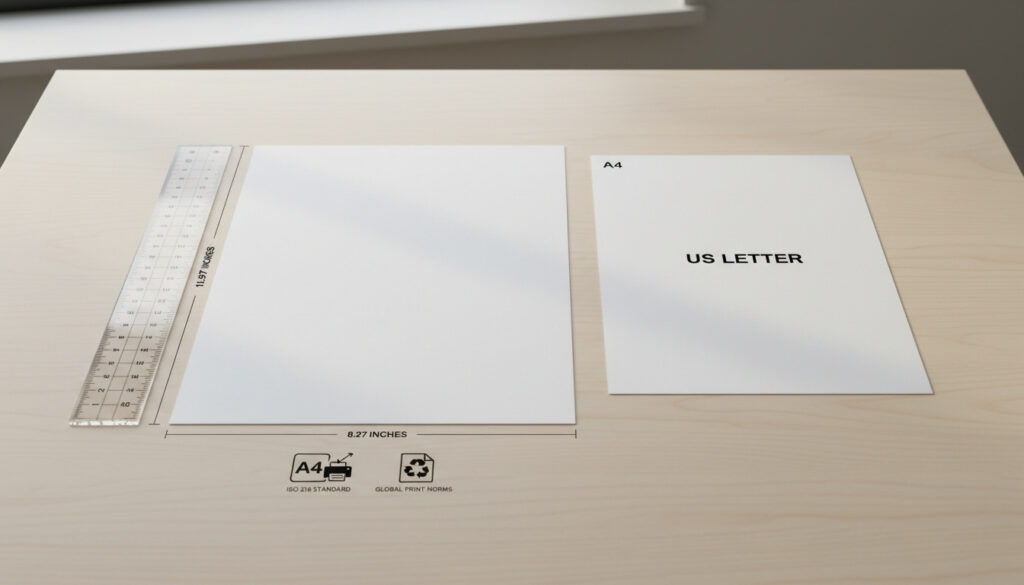
A4 paper measures precisely 210 millimetres by 297 millimetres. In imperial units, this converts to 8.27 inches in width and 11.7 inches in height, making it the most widely used paper format for documents, letters, and printing across the majority of the world.
Defined under the international standard ISO 216, the A4 format serves as the default size for stationery, office documents, and professional correspondence in every continent except North America. Its dimensions result from a mathematical ratio that allows seamless scaling between sizes.
Exact measurements in multiple units, comparisons to North American Letter size, and the systematic design principles behind the global standard are detailed below.
What is the Size of A4 Paper in Inches?
Standard A4 dimensions translate to 8.27 inches wide by 11.7 inches tall. These values represent rounded conversions from the exact metric definition, where 210 millimetres equals 8.2677 inches and 297 millimetres converts to 11.6929 inches using the international inch of 25.4 millimetres.
8.27 inches
11.7 inches
96.9 sq inches
1:1.414 (√2)
- The ISO 216 standard defines A4 as exactly 210 × 297 mm, with inch measurements being mathematical conversions rather than primary definitions.
- At 8.27 inches wide, A4 is slightly narrower than US Letter (8.5 inches), creating compatibility issues in cross-border printing.
- The height of 11.7 inches exceeds US Letter by 0.7 inches, often causing pagination errors when documents are transferred between formats.
- The surface area covers approximately 0.0625 square metres or 96.8752 square inches.
- A4 represents the fourth size in the A-series progression, being one-sixteenth the area of A0.
- The format maintains a 1:√2 aspect ratio, ensuring proportional scaling when folded or enlarged.
| Specification | Width | Height | Notes |
|---|---|---|---|
| ISO 216 Definition | 210 mm | 297 mm | Exact standard |
| Metric (cm) | 21.0 cm | 29.7 cm | Direct conversion |
| Imperial (rounded) | 8.27 in | 11.7 in | Industry standard |
| Imperial (precise) | 8.2677 in | 11.6929 in | 25.4mm basis |
| Surface Area | 0.0625 m² | 1/16 square metre | |
| Aspect Ratio | 1:1.414 | √2 proportion | |
What Are the Dimensions of A4 Paper?
Understanding A4 requires examining its definition across measurement systems, from the exact millimetre specification to practical conversions.
Metric Definition
ISO 216 establishes A4 at exactly 210 millimetres in width and 297 millimetres in height. This definition originates from the German DIN 476 standard formalised in 1922, which established the mathematical relationship between paper sizes based on the square root of two.
Imperial Conversions
Converting the metric dimensions yields approximately 8.27 inches by 11.7 inches. The conversion factor of 25.4 millimetres per inch produces slight variations in the third decimal place, with 210mm equalling exactly 8.2677165 inches and 297mm converting to 11.692913 inches. Most commercial specifications round these to two decimal places for practical use.
While ISO 216 defines A4 in exact millimetres, inch measurements vary slightly by manufacturer. Industry tolerance typically allows ±1.5mm for dimensions under 150mm and ±2mm for larger sheets, which can affect precise inch conversions in high-precision printing environments.
Is A4 the Same as Letter Size?
North American Letter size differs significantly from the international A4 standard, creating ongoing challenges for global document exchange.
Dimensional Comparison
North American Letter size measures 8.5 inches by 11 inches (215.9 × 279.4 mm), differing significantly from A4. A4 is 0.23 inches narrower but 0.7 inches taller than Letter. This discrepancy causes formatting issues when printing documents designed for one system on the other, often resulting in unwanted page breaks or margin shifts.
The Scaling Advantage
Unlike US paper sizes, which follow arbitrary historical dimensions, A4 maintains the √2 aspect ratio. This mathematical proportion allows each subsequent size in the A-series (A5, A6, etc.) to maintain identical proportions when created by folding the previous size in half. US Letter and Legal sizes lack this consistent proportional relationship.
How Does A4 Fit Within the A-Series?
The A-series follows a geometric progression where each size represents half the area of the previous. A4 is exactly 16 times smaller than A0, the base size with one square metre area.
| Size | Millimetres | Centimetres | Inches |
|---|---|---|---|
| A0 | 841 × 1189 | 84.1 × 118.9 | 33.1 × 46.8 |
| A1 | 594 × 841 | 59.4 × 84.1 | 23.4 × 33.1 |
| A2 | 420 × 594 | 42.0 × 59.4 | 16.5 × 23.4 |
| A3 | 297 × 420 | 29.7 × 42.0 | 11.7 × 16.5 |
| A4 | 210 × 297 | 21.0 × 29.7 | 8.3 × 11.7 |
| A5 | 148 × 210 | 14.8 × 21.0 | 5.8 × 8.3 |
| A6 | 105 × 148 | 10.5 × 14.8 | 4.1 × 5.8 |
A4 paper fits unfolded into a C4 envelope (229 × 324 mm). When folded in half, it fits a C5 envelope (162 × 229 mm), and folded in thirds, it fits a DL envelope (110 × 220 mm).
While ISO 216 adoption is nearly universal, North America and parts of Central and South America continue to use Letter, Legal, and Tabloid sizes. International correspondence should verify recipient paper standards to avoid formatting errors.
When Did A4 Become the International Standard?
- : German scientist Georg Christoph Lichtenberg first describes the √2 aspect ratio in a letter to Johann Beckmann, proposing it as an ideal proportion for paper formats.
- : Walter Portsmann formalises the DIN 476 standard in Germany, establishing the A-series including the A4 format based on Lichtenberg’s principles.
- : The International Organization for Standardization adopts ISO 216, making the A-series including A4 the global standard for paper sizes.
- : A4 serves as the official standard in 99% of countries worldwide, excluding the United States, Canada, and parts of Mexico, Colombia, Venezuela, Chile, the Philippines, and Costa Rica.
How Precise Are A4 Measurements?
| Established Information | Information That Remains Variable |
|---|---|
| ISO 216 defines exact dimensions as 210 × 297 mm | Exact inch conversion varies between 8.26-8.27″ and 11.69-11.7″ |
| Aspect ratio is precisely 1:√2 (1.4142…) | Manufacturing tolerances allow ±2mm variation in production |
| Standardised across 99% of global markets | Printer driver interpretations of “A4” may vary slightly |
| Surface area exactly 1/16 square metre | Digital pixel dimensions depend on resolution (DPI) settings |
Why Was the A4 Format Designed This Way?
The A-series geometry emerges from practical necessity and mathematical elegance. The √2 aspect ratio ensures that when a sheet is folded parallel to its shorter sides, the resulting half-sheet maintains identical proportions. This property eliminates wasted space and scaling distortion when enlarging or reducing documents between sizes.
Each A-series size represents a halving of the previous. A0 possesses one square metre of surface area; A1 is half that, A2 one quarter, continuing down to A4 at one-sixteenth. This systematic approach to paper sizing, unlike What Is a Dependent Variable relationships in experimental research, follows deterministic geometric principles where dimensions remain constant regardless of external factors.
What Do Official Standards Say?
The A-series paper sizes are defined by the international standard ISO 216, maintaining an aspect ratio of the square root of two. Each subsequent size is created by halving the preceding sheet parallel to its shorter sides.
International Organization for Standardization, ISO 216
The consistent aspect ratio of √2 allows for seamless scaling between different paper sizes without distortion, a property first observed by Lichtenberg in 1786 and later formalised in DIN 476.
Adobe Design Standards documentation
Key Takeaways on A4 Dimensions
A4 paper measures exactly 210 × 297 millimetres, converting to approximately 8.27 × 11.7 inches. This format, standardised under ISO 216 and derived from the √2 aspect ratio, dominates global document printing outside North America. Understanding these precise dimensions ensures compatibility with international correspondence and printing systems. For related reading, see the Puffing Billy Railway Guide.
Frequently Asked Questions
What is A4 size in cm?
A4 measures 21.0 centimetres in width and 29.7 centimetres in height.
How many inches is 210 mm?
210 millimetres equals approximately 8.27 inches, calculated by dividing by 25.4 millimetres per inch.
What is the aspect ratio of A4?
A4 maintains an aspect ratio of 1 to √2, approximately 1:1.414, allowing proportional scaling when folded.
Can I use A4 paper in US printers?
Most modern US printers support A4, though default settings often assume Letter size. Check printer specifications and adjust settings to avoid misalignment.
Why does A4 differ from US Letter?
A4 follows the ISO 216 international standard based on metric measurements and the √2 ratio, while US Letter originates from historical American paper standards based on imperial units.
More related posts
 Lesbian Space Princess: Age Rating, Reviews & Where to Watch
 Average Income Australia – 2024 Stats, States and Taxes
 Ali Larter: Biography, Children, Net Worth, and Career Comeback
 Max Verstappen Mercedes: Will He Join? Latest Talks & 2026 Update
 Human Cat Years Calculator: Real Age Formula
 Song Ji-hyo: Biography, Relationships & Controversy
 Todd Goldstein Retirement: Career, Family & What’s Next
 MAFS 2025 Cast: Who Is Still Together? Status & Legal Drama
