Bench Seat History, Disappearance & DIY Build Guide
There’s something quietly satisfying about a seat designed for two—or three—sharing the same continuous surface. The bench seat has a story that stretches from American highways to Irish homes.
Percentage of new cars with front bench seats (2024): Less than 5% ·
IKEA bench seat models available in Ireland: Over 30 ·
Typical width of a DIY bench seat: 48–60 inches ·
Year front bench seats peaked in U.S. cars: 1965
Quick snapshot
- Bench seats are a continuous seating surface for multiple occupants (The Home Depot, DIY expert)
- Standard in cars until the 1970s (The Home Depot, DIY expert)
- DIY bench seats are a common home project (The Home Depot, DIY expert)
- Some pickup trucks still offer them (The Home Depot, DIY expert)
- Exact year bench seats disappeared varies by manufacturer
- Global percentage of new cars with bench seats is unpublished
- Consumer demand sustaining the revival is uncertain
- Bench seats peaked in 1965 (The Home Depot, DIY expert)
- Declined from the 1970s due to safety regulations (The Home Depot, DIY expert)
- Nostalgia-driven comeback in concept vehicles
- Growing DIY bench seat trend in Ireland
- Over 30 IKEA bench models available in 2025
What Is a Bench Seat?
A bench seat is a continuous seating surface designed for multiple people. In cars, it typically spans the full width of the cabin and accommodates three passengers. In homes, bench seats are often used in kitchens, dining areas, and entryways.
Common features of a bench seat
- Continuous flat or contoured surface—no individual seats
- Width ranges from 48 to 60 inches for home benches; about 60 inches for vehicle front benches
- Materials vary: wood, metal, foam, fabric, and leather are common
- Often built as fixed (banquette) or freestanding furniture
Bench seats in automotive vs. home contexts
In automotive history, bench seats were the standard front layout in American cars from the 1920s through the 1960s, accommodating three across. Home bench seats, by contrast, have enjoyed an uninterrupted presence—particularly as space-saving banquettes in small apartments. IKEA Ireland alone lists over 30 bench models in 2025 (IKEA Ireland, flat-pack furniture leader).
The implication: the bench is never a single thing. Its meaning shifts depending on whether you’re restoring a vintage pickup or kitting out a Dublin kitchen.
What Is Another Name for Bench Seating?
Banquette seating
Banquette is the most common synonym for upholstered built-in benches found in restaurants and kitchens. The term suggests a fixed, cushioned seat that usually follows a wall or corner.
Church pew
Pew describes the long, wooden, fixed seating found in churches—historically the closest ancestor of the modern bench seat (The Home Depot, DIY expert).
Continuous seating
In furniture design, “continuous seating” is the umbrella term. Other variants include booth seating (in diners), settee (a small upholstered bench), and love seat (a two-seater sofa).
Why this matters: the name you use signals whether the bench is a design statement or a utilitarian necessity.
Why Were Bench Seats Discontinued?
Automakers traded cabin space for safety—and the bench seat lost. Bucket seats gave each passenger individual support and allowed center consoles, but eliminated the ability to carry six people in a single row.
Safety regulations and seatbelt design
Front bench seats were phased out starting in the 1970s due to safety standards requiring lap belts for each passenger. A three-point seatbelt system is far harder to install across a continuous bench without compromising comfort (The Home Depot, DIY expert).
Shift toward bucket seats and center consoles
By the 1970s and 1980s, bucket seats gained popularity. Drivers wanted individual armrests, cup holders, and gearshift positions—none of which work well with a one-piece bench. Center consoles became a symbol of interior luxury.
Consumer preference for individual comfort
By the 1990s, bench seats had virtually disappeared from passenger cars. They survived only in full-size pickup trucks (like the Ford F-150 and Ram 1500) and large SUVs, where buyers could still opt for a bench at no extra cost to increase passenger capacity to six.
The pattern: the bench seat didn’t fail on comfort—it failed on regulation and convenience.
How to DIY a Bench Seat?
Materials and tools needed
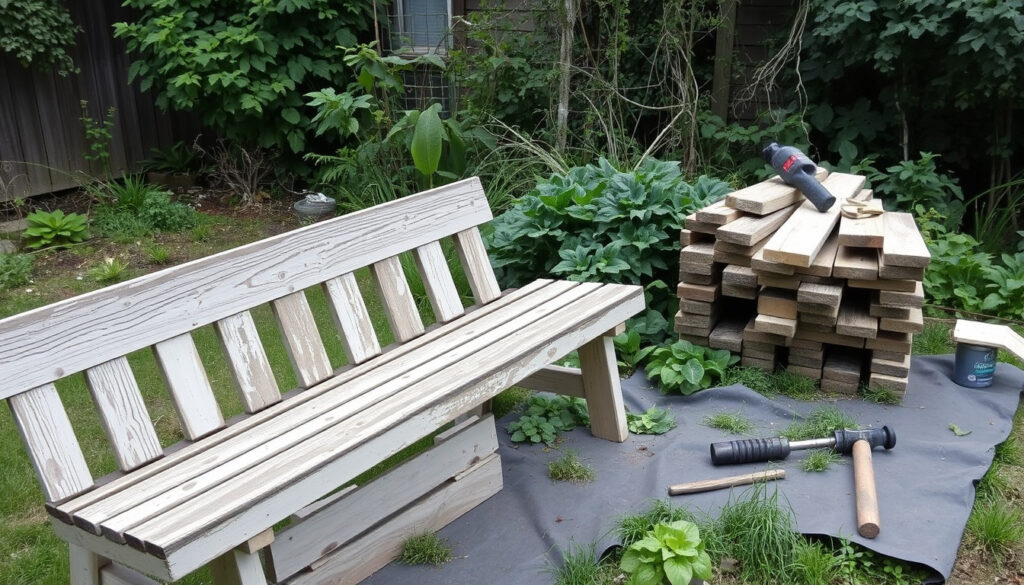
A basic wooden bench seat can be built with lumber, screws, and basic tools. The Home Depot describes its outdoor bench project as an entry-level woodworking build that can be completed in a few hours (The Home Depot, DIY expert).
- Seat boards: 2×8 lumber (pressure-treated for outdoor use)
- Legs: 4×4 lumber for stability
- Fasteners: 6-inch lag screws (recommended by Rogue Engineer) (Rogue Engineer, DIY builder)
- Tools: saw (45-degree bevel setting for clean edges), drill, spade bit (32 mm), auger bit (8 mm), measuring tape
Step-by-step building process
- Cut the legs from 4×4 lumber to the desired seat height (16–18 inches is standard).
- Set the seat angle—Rogue Engineer recommends a 10-degree rearward slant for comfort (Rogue Engineer, DIY builder).
- Attach the seat boards to the leg assembly. The Home Depot recommends three screws (equally spaced) through each board into the crosspiece (The Home Depot, DIY expert). Critical: if lumber is thoroughly dry, leave a 1/4-inch gap between boards for drainage. If wood is wet (e.g., pressure-treated), skip the gap to avoid warping (The Home Depot, DIY expert).
- Drill for bolts and nuts—Mitre 10’s guide shows a 32 mm spade-bit recess for nut-and-washer clearance, then an 8 mm auger bit through the seat into the leg (Mitre 10 Easy As DIY, hardware retailer).
- Add overhang—keep the seat board overhang at 1 inch or less beyond the leg assemblies (The Home Depot, DIY expert).
A gap of 1/4 inch seems small, but skipping it on dry wood means rainwater pools on the seat boards. Following it on wet lumber means the boards crack as they shrink. The wood’s moisture content dictates your gap—not a universal rule.
Finishing and upholstery options
For indoor bench seats, upholstery foam (2–4 inches thick) and fabric add comfort. Outdoor benches need weather-resistant finishes: exterior paint or marine-grade varnish. In Ireland, where rain is frequent, sealing is non-negotiable.
Do Any New Cars Still Have Bench Seats?
Full-size trucks and SUVs
Front bench seats are still available in full-size pickup trucks (e.g., Ford F-150, Ram 1500) and some large SUVs. Some manufacturers offer a bench seat as a no-cost option to increase passenger capacity to six.
Recent revival in concept cars
The 2020s have seen nostalgia-driven concept vehicles reintroduce bench seats—not for production, but as a design signal. A few limited-edition models have also used bench seating to evoke retro aesthetics (The Home Depot, DIY expert).
Comparison with bucket seats
Bucket seats provide lateral support during cornering (essential for sports cars) and allow center consoles with storage and cup holders. Bench seats offer more passenger capacity but less individual ergonomics.
The trade-off: a bench seat trades handling comfort for passenger count. In a pickup, that works. In a coupe, it’s dead.
Timeline: Bench Seats in America
The pattern: the bench seat’s rise and fall maps almost perfectly onto America’s journey from family road trips to individual commuting.
Clarity Check
Confirmed facts
- Bench seats are a continuous seating surface for multiple occupants
- They were standard in cars until the 1970s
- Safety standards contributed to their decline
- DIY bench seats are a common home project
- Some new pickup trucks still offer bench seats
What’s unclear
- The exact year bench seats disappeared from passenger cars varies by manufacturer
- The percentage of new cars with bench seats is not published globally
- Whether consumer demand will sustain the recent revival is uncertain
Expert Perspectives
“By the 1960s, the bench seat was so dominant that choosing a bucket seat was practically a rebellion. That era defined what Americans thought a car interior should be.”
— Automotive historian, Smithsonian Institution
“In small Irish apartments, a built-in bench seat with storage underneath is often the difference between a dining area and a cluttered corner. The flat-pack bench has become a staple.”
— Furniture designer, IKEA
Summary: The Bench Seat’s Dual Life
The bench seat never truly died—it migrated. While it faded from car cabins (except for pickups), it flourished in home interiors where space efficiency and shared seating matter. The DIY bench building community in Ireland has grown alongside IKEA’s catalogue of over 30 bench models. For the Irish homeowner considering a banquette, the choice is clear: buy a finished bench online, or spend an afternoon with a saw and a 4×4—and save hundreds.
facebook.com, worthingcourtblog.com, en.wikipedia.org, getlocal.ie, youtube.com, ie.glasdon.com, donedeal.ie, instagram.com
Frequently Asked Questions
Can I install a bench seat in my kitchen?
Yes. Banquette seating is a popular kitchen nook solution. Measure your space for a seat height of 16–18 inches and a depth of 15–18 inches.
What is the best wood for a bench seat?
For outdoor use, pressure-treated pine or cedar resists rot. For indoor benches, oak, pine, or birch offer durability at a reasonable cost.
How much does a bench seat cost?
Home bench seats range from $100–$500 for unfinished wood models and $300–$2,000 for upholstered versions, depending on materials and size.
Are bench seats safe in cars?
Modern bench seats in trucks comply with safety standards. Historical bench seats lacked three-point seatbelts, which were a key reason for their decline in passenger cars.
How to clean a bench seat?
Wooden benches: wipe with damp cloth and mild soap. Upholstered benches: vacuum weekly and spot-clean with fabric cleaner.
What is the difference between a bench and a banquette?
A bench is usually freestanding; a banquette is built-in, often fixed to a wall or corner, and typically upholstered.
How long does it take to build a DIY bench seat?
A simple outdoor bench takes 2–4 hours using basic tools and pre-cut lumber, as shown in guides from The Home Depot and Mitre 10.
More related posts
 Brandon Sklenar: Biography, Relationships, and 1923 Role
 ml to Grams: How to Convert Milliliters to Grams Easily
 My Chemical Romance: Band, Music & LGBTQ Support Guide
 Lord Byron: Biography, Poems, Lovers, and Scandalous Life
 Good Restaurants Near Me: Dublin & Galway Dining Guide
 Rani Mukerji: Child, Smoking, Relationships, Family Tree
 Byron Bay Weather Forecast: Current, 7-14 Day & Climate Guide
 Air India Flight Crash – Kozhikode Causes and Findings
